Essay Revision
Essay planning
Paragraphs are beautiful - a four step fail safe plan
To do: Writing a TEEL paragraph
Topic: Begin EACH new paragraph with a clear and precise topic sentence that refers directly to the content of the paragraph. The topic sentence tells the reader what the paragraph is about, or its main idea
Explain: Explain what you mean in greater detail.
Evidence: Provide evidence to support your idea or claim. To do this, refer to your research. This may include: case studies, statistics, documentary evidence, academic books or journal articles. Remember that all evidence will require appropriate citation.
Link: Summarise the main idea of the paragraph, and make clear how this paragraph supports your overall argument. The linking sentence links one paragraph to the next and provides another device for helping you ensure your text is cohesive.
Essay questions. The essay is worth 15 marks.
Answer one (1) of the essay questions. In the essay, discuss the extent to which you agree with the proposition.
Use evidence to support your argument and conclusion.
The following are key concepts from each topic studied in 11 History. We will make plans for each in class.
Imperialism topic.
1. Evaluate the main causes of European imperialism.
2. Discuss the positive and negative impacts of European colonisation for colonised countries.
Decolonisation topic
3. How the European colonial powers responded to calls for independence in their colonies.
4. Causes of the end of the European colonial period after WW2.
Decolonisation and the Cold War topic
5. The impact of the Cold War on newly independent nations.
6. The role of the superpowers in shaping newly independent nations.
Sources Revision
Sources Analysis Answer Guide
Don’t forget: Quote often and begin your response with name of the author, not the Source number. Put the source number in brackets at the end of the quote/paraphrasing.
For example:
This is supported by Jones who states that 'History students would be more popular at parties if they used this method.' (Source 3)
SACE Sources advice
More successful responses:
were well-structured
contained relevant evidence from sources when required.
Less successful responses
provided responses without reference to any evidence from the source
stated that sources are limited without reasoning
did not address the nature of sources clearly
did not explain how the nature and origin of the sources were a strength or limitation
did not include of the source in the response.
Sources. The Battle of Waterloo
The sources questions are worth 20 marks.
The Battle of Waterloo
On 18 June 181 5, outside the village of Waterloo (in present-day Belgium), the Duke of Wellington's British troops, along with General
Blücher's Prussian forces, defeated Napoleon Bonaparte's French imperial army. This climactic battle ended Napoleon's reign and brought
a century of relative peace to Europe. Napoleon was later sent into exile on the island of St Helena, where he died in 1821.
Source 1. Talks of Napoleon at St Helena with General Baron Gourgaud,
'The men of 1815 were not the same as those of 1792. My generals were faint hearted men. Perhaps I should have waited another month before opening the campaign in order to give consistency to the army. I needed a good officer to command my guard. If I had had Bessiers or Lannes at its head I should not have been defeated. I ought to have had mounted grenadiers in reserve, their charge would have altered state of affairs.'
Adapted from Gourgaud, G 1815—18, Talks of Napoleon at St Helena with General Baron Gourgaud, Wentworth Press 2016, pp 185—88
Questions
1. According to Source 1, what was one characteristic of Napoleon's officers? (1)
Source 2. The causes of Napoleon Bonaparte's loss at Waterloo 1815
The are several reasons Napoleon failed at Waterloo. A significant factor in Napoleon's defeat was Blucher's timely arrival, which was not anticipated by the French. Napoleon had not prepared for the arrival of the Prussian army. Wellington, in his despatches to London, made it clear how important Blucher's arrival was to the battle outcome.
Another factor was the terrible weather. Heavy rain had turned much of the battlefield into a mud bath, which had greatly slowed the French during their attacks. This was particularly the case given that the forces of Napoleon were attacking uphill.[15] The weather had also delayed the French attack by several hours, and this was to prove crucial.
If the French had been able to attack in the early hours, they could have swept the British from the field before their Prussian allies' arrival. Then there was Napoleon’s mistake in organizing the first attack on the British center. The formation of the First French Corps was not suitable for a swift attack, and this meant that it was relatively ineffective. According to an official French investigation into the battle, the ‘inconceivable formation of the first corps, in masses very much too deep for the first grand attack.’
Adapted from Huh, E 2013, 'The causes of Napoleon Bonaparte's loss at Waterloo 181 5,' Emory. Endeavors in History, vol 5, pp 1 64—83, Emory College of Arts and Sciences.
Questions
2. Using evidence from Source 2, identify two factors that contributed to Napoleon's defeat. (2)
Source 3. Waterloo: The True Story of Four Days, Three Armies and Three Battles. B Cornwell 2016
“The survivors of that confusion would surely be bemused by the argument that Waterloo really was not that important, that if Napoleon had won then he would have still faced overwhelming enemies and ultimate defeat. That is probably, though not certainly, true. If the Emperor had forced the ridge of Mont St Jean and driven Wellington back into a precipitate retreat, he would still have had to cope with the mighty armies of Austria and Russia that were marching towards France. Yet that did not happen. Napoleon was stopped at Waterloo, and that gives the battle its significance. It is a turning point of history, and to say history would have turned anyway is not to reduce the importance of the moment it happened.”
Questions
3. What are two conclusions that can be drawn about the importance of Waterloo from Source 3? (2)
Source 4. The battle of Waterloo - royalmontrealregiment.com/
Upon Napoleon’s return to power in March 1815, many states that had opposed him formed the Seventh Coalition and began to mobilise armies. Two large forces under Wellington and Blücher assembled close to the north-eastern border of France. Napoleon chose to attack in the hope of destroying them before they could join in a coordinated invasion of France with other members of the coalition. Waterloo was the decisive engagement of the Waterloo Campaign and Napoleon’s last. According to Wellington, the battle was “the nearest-run thing you ever saw in your life”. The defeat at Waterloo ended Napoleon’s rule as Emperor of the French, and marked the end of his Hundred Days return from exile.
Source 5.
Watch an excerpt (47:00 to 50:08) of the film The Battle of Waterloo 1875, The History of Warfare (TV series)
Questions
4. To what extent does the information in Source 4 support the information in Source 5?
Justify your answer with evidence from each source. (4)
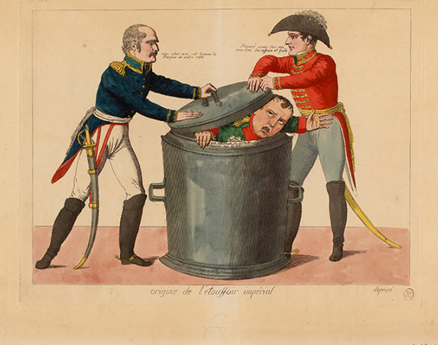
Source 6. Lacroix, J 1815, Origine de l'étouffoir impérial, Paris Musées / Musée Carnavalet,
Blücher (the Prussian General, on the left, as he and the British Duke of Wellington attempt to finally subdue Napoleon): 'My dear friend, that man is breathing on your side.' Wellington (on the right): 'Trust me, my friend. His business is done.' Napoleon (softly): 'Gentlemen, don't extinguish me; spare my life.'
Questions
5. Examine Source 6. With reference to the origin and nature of the source, assess the strengths and limitations for historians investigating the Battle of Waterloo. (4)
6. Evaluate this statement with reference to all the sources. (6)
'The French were largely responsible for their own defeat at the Battle of Waterloo.'