Globalisation refers to the process by which the world’s local and regional economies, societies, and cultures have become integrated together through a global network of communication, transportation and trade.
Globalisation is thought of as a recent phenomenon that is driven by inventions like the airplane or the Internet. However, globalisation has been taken place for centuries; it is just that the pace of this process is accelerating.
The Silk Road is a great example of early globalisation, which spanned from Europe to Indonesia, moving silk and other products from as early as the 2nd century BC.
Causes of globalisation
The world is more Interconnected due to advances in transport
The world is more interconnected due to advances in telecommunications
The massive expansion of world trade, due primarily to the growth of Multi National Corporations (MNC's)
Note: A multinational corporation (MNC) is a large company that operates in more than one country. It has its headquarters in one nation but owns or controls production, sales, or services in several others.
EG. Coca Cola, Apple, and Toyota all manufacture, market, and sell globally while being headquartered in one country.
The growth of money markets, making it easier for capital to move around the world
1. Globalisation Fieldwork
Globalisation is the process of the world becoming more connected through trade, technology, culture, and ideas. It allows goods, services, and information to move quickly across borders. This creates opportunities for economic growth and cultural exchange, but also challenges such as inequality, environmental impacts, and the loss of local traditions.
Station 1. What is Globalisation?
Globalisation is the increasing interconnectedness of people, economies, cultures, and governments worldwide, driven by trade, communication, migration, and technology, shaping shared opportunities, challenges, and interdependence across borders.
Globalisation is a result of the following changes to the global economy:
Improvements in transportation - larger cargo ships mean that the cost of transporting goods between countries has decreased. Economies of scale mean the cost per item can reduce when operating on a larger scale. Transport improvements also mean that goods and people can travel more quickly.
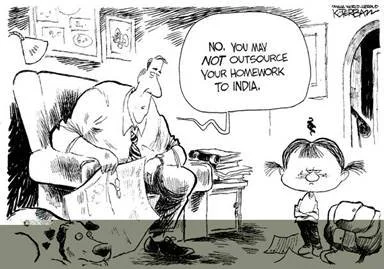
Labour availability and skills - countries such as India have lower labour costs (about a third of that of Australia) and also high skill levels. Labour intensive industries such as clothing can take advantage of cheaper labour costs and reduced legal restrictions in LEDCs.
Improving communications - the internet and mobile technology has allowed greater communication between people in different countries.
To do: Questions
Define Globalisation
List three (3) causes of Globalisation
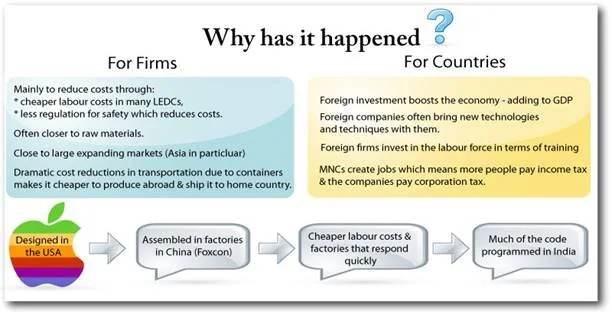
Refer to source 1. How does Globalisation benefit companies (Firms) that can outsource work and manufacturing to other countries?
Refer to source 1. How does globalisation / foreign investment benefit countries?
Refer to source 1. What are the four (4) stages of the production and distribution of an iPhone
Station 2. Globalisation and Transport Case Study - Apple
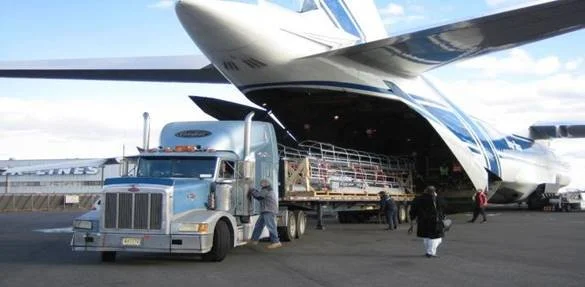
Improvements in Transport include; increase in airports, improved air transport, high speed trains & larger container ships.
This makes it easier to source supplies from all over the world as well as exporting products all over the world.
Apple ships iPhones to the US and Europe in Boeing 777’s
Each plane can carry 450 000 iPhones
It costs $250 000 to charter a 777
About 55 cents per phone
A container ship would take about one month to get from China to Europe and cost about 1 cent per phone
To do: questions
Why does Apple use planes and not container ships to transport its phones?
Explain how the decline in the cost of transport can influence where factories are located.
Source 1. Why Globalisation?
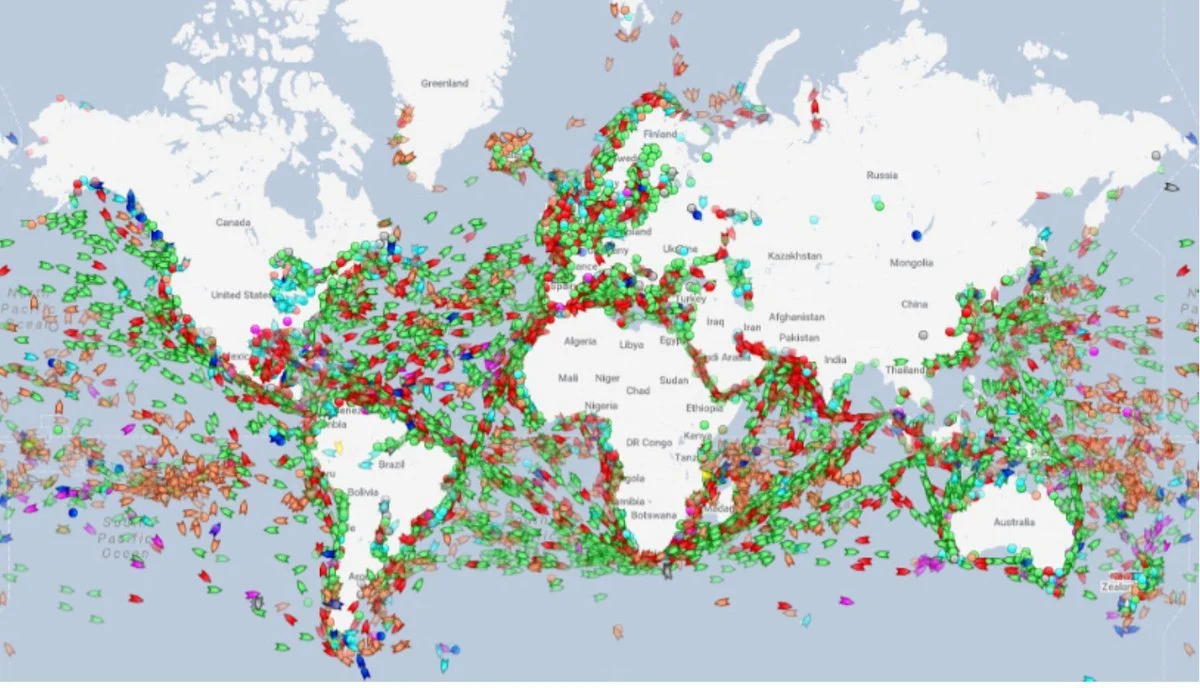
Globalisation fun fact.
There are approximately 180,000+ ships at sea on a given day.
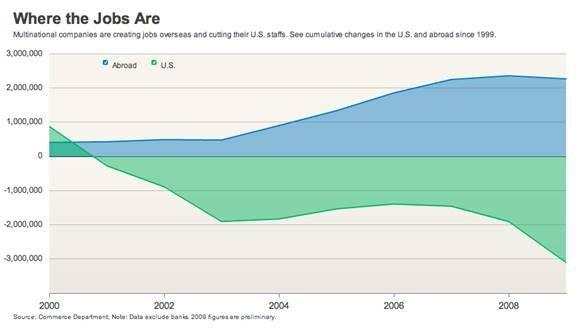
Station 3. Where the jobs are.
Globalisation enables companies to move jobs overseas, seeking lower labour costs and wider markets. While it can increase efficiency and global trade, it often leads to job losses in the home countries, raising concerns about inequality, working conditions, and economic dependency between developed and developing nations.
To do: Refer to Source 2.
Describe the trend in manufacturing jobs in the USA.
Describe the trend in offshore jobs (Abroad).
Extra: What is the benefit for western consumers of manufacturing jobs being moved to LEDC’s (Abroad)
Station 4. Globalisation and communication
Improvements in ICT (Information communication technology) have made it quicker and more convenient for businesses all over the globe to communicate with each other in person.
E.g. Nike’s Headquarters are in Oregon, USA and the company has many manufacturing locations situated in South-east Asia.
Call Centres
Call centres are used by some companies to handle telephone enquiries about their business. Improvements in technology mean that it is just as easy to phone someone in a foreign country as in the same country. As a result, companies can relocate call centres to countries were the labour cost is cheaper which increases the profit of the company.
For example, labour costs in countries like India or the Philippines are typically 50–70% lower than in developed countries. A call centre worker in the US or UK might earn USD $25,000–40,000 per year, while in India or the Philippines wages are often USD $5,000–10,000 per year for the same role.
To do: questions
List the reasons that many MNC"s moved their call centres to LEDC's?
How do improvements in ICT allow Nike to manufacture shoes in SE Asia?
Station 5. China case study: The new Economic Giant
In 30 years China has gone from being an agricultural economy to a strong manufacturing economy. (2nd largest in world).
The number of products produced has increased rapidly.
In 1978. China sold 4000 TVs.
In 2024, China sold about 110 million TVs
Many MNC’s have factories in China e.g. Nike, Disney and Apple
There are a number of reasons for the growth in manufacturing in China:
Cheap labour: There is no single minimum wage in China; it differs from province to province. E.g. in Shenzhen the minimum wage is about $180 per month, whereas in Beijing it is about $140 per month. This makes China much cheaper than MEDC’s like Australia where the minimum wage is about $2640 per month.
Working Hours: Chinese law states that workers should work for a maximum of 40 hours a week with 36 hours of overtime per month. This however is not enforced and some MNC’s like Nike make workers work 80 hours of overtime per month to maximise the production of goods.
Lax Health & Safety Regulations: Although the health & safety laws in China are similar to those in the Australia, they are not heavily enforced.
E.g. in the last 10 years, hundreds of Chinese factory workers have been treated for mercury poisoning despite China’s strict laws regarding working with toxic materials.
Tax Incentives & Tax Free Zones: China has many Special Economic Zones that offer tax incentives for MNC’s. This means that MNC’s pay no tax for the first two years in the zone, 7.5% for the next three years and then 15% from then on. This is still half of the usual amount businesses have to pay in other areas of China.
To do: questions
What is the difference between the minimum wage in China and Australia?
How might this affect employment in Australia in the future?
Globalisation is often blamed for declining worker conditions, explain why this is happening.
How have MNC’s benefited from moving production to LEDC’s like China?
Electronics manufacturing (like the ipad) uses toxic materials and heavy metals, describe how lax health and safety regulations would make China a cheaper place to manufacture these items.
Can you think of reasons why LEDC’s like China would encourage MNC’s to invest using tax incentives?
Extra: Outline the factors that are preventing our Geography class from opening an iPhone manufacturing factory in Blackwood.
Source 2. Where the jobs are
2. The Clone Town
Activity 2: Clone Town Survey
Critics of Globalisation say that it leads to all places starting to look the same, becoming Clone towns. They argue that as multinational chains expand, local shops close, and town centres become filled with the same fast-food outlets, clothing brands, and supermarkets. This creates “clone towns” places that lose unique cultural identity and look increasingly similar everywhere.
We will complete virtual fieldwork to assess whether Adelaide (Rundle Mall) has become a Clone town.
How to do the Clone town survey
Survey area
Drop the Google Guy on the Rundle Mall in Adelaide.
You simply need to navigate along the mall and record the first 50+ shops you pass on the survey sheet.
You can do both sides of the mall.
Only count retail stores NOT services such as post offices and banks.
Completing the survey
Record the following details for each store/service.
Whether it is a locally independently owned shop or part of a national or international chain
The type of shop EG Clothing or Fast Food.
Calculating the Clone town rating of Rundle Mall Adelaide.
Calculate the total number of locally owned shops.
Then multiply the total number of locally owned shops by 75.
Add up the total number of shops surveyed (local and international)
Divide the locally owned figure, by the total number of shops surveyed
Add this final figure to the total number of types of shops surveyed
This gives you your Clone town score.
If you prefer equations.
Number of locally owned shops x 75 / Total number of shops + Number of types of shops =
Use the clone town rating scale to identify where on the scale Rundle Mall rates as a globalised clone.
Extra: Visit a major shopping precinct in another Asian city and complete the Clone Town survey. Is it more globalised than Adelaide?

3. Sweatshops
Background briefing: Fast Fashion
Fast fashion is closely linked to globalisation, as clothing companies source cheap labour and materials from developing countries (LEDC’s) to produce garments quickly and at low cost. The growth of global supply chains allow brands to design in one country, manufacture in another, and sell worldwide.
This creates affordable clothing but also raises concerns about worker exploitation, environmental damage, and unsustainable consumption patterns, showing both the benefits and costs of global economic integration.
To do: Documentary analysis. Who pays the cost?
Watch the documentary and identify examples of the positive and negative impacts of the rapid growth of the garment industry in Bangladesh.
Environmental impacts
Social impacts
Economic impacts
Extra: The rapid urbanisation in LEDC’s such as Bangladesh is linked to rural migrants seeking jobs in garment industries. The growth of these industries was seen as a first step to improving development in countries such as China and Korea.
How could the growth of these industries be a positive factor in the development on countries such as Bangladesh?
Activity 3. Are sweat shops good or bad?
A sweatshop is a workplace in a developing country (LEDC) often in clothing, footwear, or electronics industries. Employees work long hours for very low wages under poor, unsafe, and exploitative conditions. Sweatshops are commonly associated with child labour, lack of workers’ rights, and violation of labour laws.
Use the following excerpts to write an article that looks at both sides of the sweat shop debate.
Sweatshops are Bad: The Danger of Sweatshops. Earth.org
A sweatshop refers to a “typically tiny manufacturing establishment employing workers under unfair and unhygienic working conditions”.
Many fast fashion retailers like H&M and Forever 21 receive new clothes shipments every day. These brands are able to sell a huge amount of clothing and at extremely low prices by contracting with suppliers in underdeveloped nations. These businesses subsequently contract out the production to unregistered vendors that do not have to abide by any laws. In other words, there is no requirement for these brands to provide safe working conditions to these workers.
Working conditions are poor, unhygienic and unsafe since a large number of sweatshops are located in poor nations with weak labour laws and little government control; as a result, if workers attempt to challenge their rights or work conditions, they risk losing their jobs. Workers in the garment industry are required to put in 14 to 16 hours per day, seven days a week, and endure verbal and sometimes even physical abuse from managers. Oftentimes, workers are exposed to harmful substances while working without enough ventilation. Accidents and injuries are also frequen
Sweatshops are Good: Sweatshops make poor people better off. Adam Smith Institute
Sweatshops are awful places to work. But they are often less awful than other jobs sweatshop workers could take. And this is the basic argument in defence of sweatshops. When people argue against them, the question we should ask is: “Compared to what?”. Most evidence suggests that sweatshops pay better than the alternatives. It’s hard to collect reliable data in many poor countries, but Ben Powell and David Skarbek’s 2006 paper “Sweatshops and Third World Living Standards” found that ‘sweatshop wages exceed average income in between eight and ten out of ten countries surveyed’.
In the villages close to sweatshops, girls were substantially less likely to get pregnant or be married off (28% and 29% respectively, and this effect was strongest among 12-18 year olds) and girls’ school enrolment rates were 38.6% higher. Famlies with higher incomes need to marry off their daughters less early, and can afford to send their daughters to school for longer. In addition, garment factory jobs reward skills, increasing the value of education.
And what do workers themselves think of sweatshops, given not just wages but other non-monetary compensation as well? Using field interviews with thirty-one sweatshop workers in El Salvador, David, Emily, Brian and Erin Skarbek found that “workers perceive factory employment to provide more desirable compensation
3. North Korea is not globalised
Activity 4. What does no globalisation look like?
We are going to create a poster examining North Korea to see what 'no globalisation' looks like.
North Korea is a country that has chosen not to join the world economy.
It is sometimes called the Hermit Kingdom because it is difficult to enter or leave and there is little communication with the outside world.
You and your fellow globalists need to create a poster examining what 'no globalisation' looks like.
To do: Include the following information on your poster
Maps
First you will need maps of the Korea's. (We suggest a night satellite map)
Development indicators
These can be used to give us a sense of the globalisation and wellbeing of a country.
Population
Real GDP per capita
Number of export partners
Number of import partners
Communication: A list of North Korean websites
North Korea is the only country in the world not connected to the internet.
TVs and radios in the country are only able to connect to pre-tuned government stations, which broadcast domestic content infused with political propaganda glorifying the country's leader, Kim Jong-un, and access to the world wide web is forbidden.
Trade: North Korea trade partners
Unlike more globalised countries, North Korea does most of it's trade with neighbouring China.
Annotate a diagram of North Korean exports.
Multi National Corporations (MNC's): Things you can't buy in North Korea
Ordinary North Koreans are resigned to a world without many of the things we Westerners take for granted. The economy is closed to the rest of the world.
The following is a list of things you cannot buy in North Korea:
Daily Life: First hand account of life in North Korea from a defector
'I lived in North Korea for the first 15 years of my life, believing Kim Jong-il was a god. I never doubted it because I didn't know anything else. I could not even imagine life outside of the regime. I had to be careful of my thoughts because I believed Kim Jong-il could read my mind.'
Fun facts about the Hermit Kingdom: Fun facts about North Korea
As one of the world’s last closed societies, North Korea has attracted global curiosity to what is sealed off between its borders. Despite an ongoing food crisis that has spanned two decades and the cascading paranoia of the political leadership, life manages to go on in the Hermit Kingdom.
Extra research :