
Decolonisation and the Cold War
Background briefing: The Cold War
Mao declared the new Chinese nation in a geopolitical climate being shaped by the political, ideological, and military rivalry between the new superpowers, the USSR and the USA.
It was not a direct war, it was a cold war Competition occurred through proxy conflicts, the arms race, and influence….. over nations newly independent after European decolonisation.
Asia became a major battleground, shaping events in China, Korea, Vietnam, and Cambodia. The Cold War influenced global politics, economics, and alliances for decades, ending with the collapse of the Soviet Union in 1991.
The Cold War. 5 key points.
Ideological conflict: capitalism vs communism
Proxy wars in Asia, Africa, and Latin America
Nuclear arms race and fear of global war
Competition for influence in newly independent nations
Formation of global alliances and divisions
To do: questions
Briefly explain the origins, conduct and outcomes of the Cold War to a non-historian.
Extra: What was China’s role in the origins of the Cold war?
1. The new colonisation. Not like the old colonisation.
The Empires are dead. Long live the Empires.
After World War II, European empires weakened and many countries in Asia and Africa gained independence through the process of decolonisation.
The Superpowers, United States and the Soviet Union, competed for influence in these newly independent nations as part of the Cold War.
Superpowers used military aid, economic assistance, and political pressure to expand their influence.
Some countries became sites of conflict or intervention, while others attempted to remain neutral through the Non-Aligned Movement.
Countries gained political independence, but the Cold War rivalry often limited their sovereignty and shaped their development.
Some countries, such as China and North Korea, adopted communism, while others aligned with Western powers. Decolonisation often led to proxy wars, including in Vietnam and Korea.
At the same time, Cold War support helped economic growth in places like Japan and South Korea.
To do: Cold War in Asia questions
According to Crash Course, why did Asia become a major battleground during the Cold War?
How did the Cold War influence decolonisation movements in countries such as China, Korea, and Vietnam?
According to Crash Course, what were the long term consequences of the Cold War conflicts in Asia?
Create a Mind Map to explain the geopolitical changes that resulted from the end of WW2.
Discuss: To what extent did the Cold War create instability in Asia after World War II?
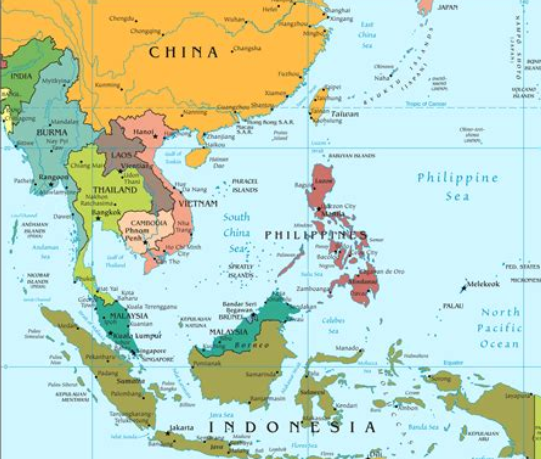
Cold War in Asia. Annotated Map
To do: Create a Cold War in Asia outcomes map:
Countries to include in the map:
China
Korea
Vietnam
Cambodia
Laos
Indonesia
Malaya
Japan
Thailand
Annotate the following for each country:
Communist / Anti-Communist
War / Political change / Insurgency
Superpower involvement
Discuss: What are the possible reasons why outcomes were so different across Asia
2. The Cold War and the newly independent nations. Its complicated
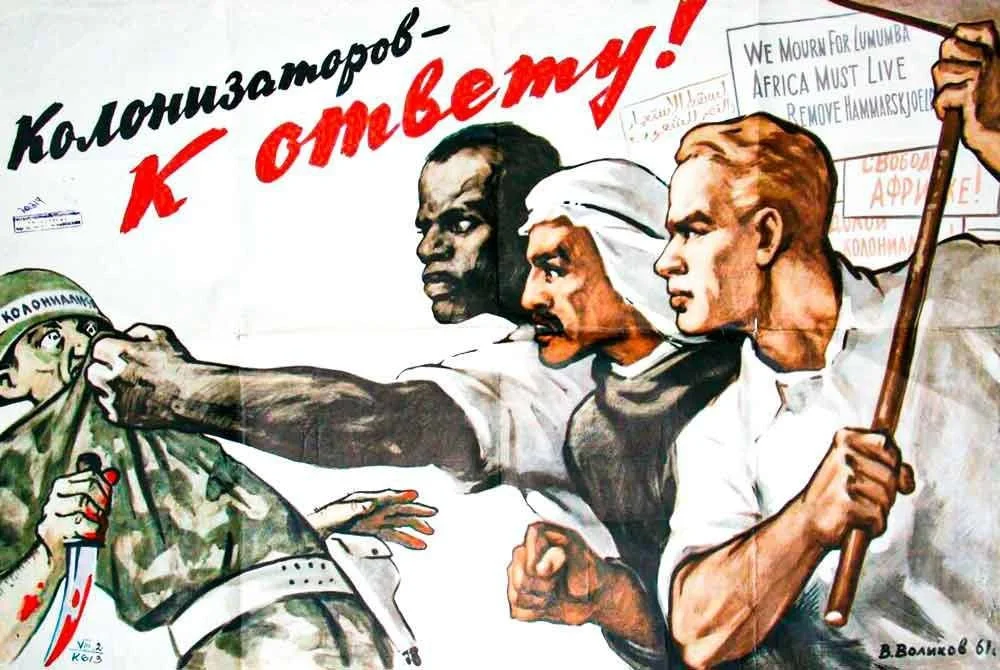
The After World War II, many nations in Asia and Africa gained independence as European empires declined. However, the emergence of the Cold War created new pressures on these states.
The United States and the Soviet Union competed for influence through military support, economic aid, and political intervention. In some cases, newly independent countries became sites of proxy conflict or external interference.
This has led some historians to argue that although formal empire ended, powerful nations continued to shape the political and economic direction of weaker states.
We are going to examine five key events during the Cold War to answer the question.
Did Cold War rivalry create a new form of colonisation?
3. The Malayan Emergency 1948 - 1960
Background briefing: Malayan Emergency
The Malayan Emergency was a conflict between British forces and communist guerrillas in Malaya (Modern day Malaysia) between 1948 and 1960. The conflict was both anti-communist and anti-colonial, as guerrillas also aimed to end British rule.
Four main causes of the Malayan emergency
Malaya was strategically important for trade and military routes, Britain hoped to keep the colony.
Tensions between British authorities and Malayan Chinese communities
Malaya was racked by social and economic problems after World War II
British plans for giving Chinese Malays citizenship were violently resisted by native Malays.
Communist groups, primarily Chinese Malays, began violence and guerrilla warfare in 1948
Australia’s Role in the Malay Emergency
Australia joined the conflict in 1950, over 7,000 Australians served and Army, Navy and Air Force units were deployed. 39 Australians died during the conflict
End of the Emergency 1960
Communist forces weakened by the mid-1950s
Guerrilla forces surrendered or fled
Malaya gained independence in 1957
To do: Malay emergency questions
Why do historians describe the Malay emergency as both an anti communist conflict and a fight for independence.
Make a 2 column table, compare the tactics used by the British and Communists in Malaya with the tactics used by both sides in the Vietnam War.
Research: Why was Britain forced to give up their colonies in Asia after WW2?
Source. The Malayan Emergency. Anzac portal
The conflict was brutal and complex. Both sides committed atrocities. The British used controversial tactics like herbicide spraying and forced relocations, while the communist guerrillas didn’t hesitate to use terror and intimidation. Thousands of lives were lost, communities were torn apart, and the social fabric of Malaya was fundamentally altered.
The origin of Hearts and Minds
You would remember the Hearts and Minds program in South Vietnam.
The phrase "hearts and minds" was first used in the context of counter insurgency warfare by the British in the Malaya conflict. A British General stated that victory in the war "lies not in pouring more soldiers into the jungle, but in the hearts and minds of the Malayan people."
The British in Malaya, in addition to military actions against the communist guerrillas undertook the following to win the herts and minds of the Malayan population.
Social and economic programs to protect and support the population.
Move the rural population into Hamlets to isolate them and reduce their supply and support of the insurgents.
Gather intelligence about the insurgents' organization and plans
Ensure that government services were provided to rural dwellers.
To do: Hearts and minds questions
Create a two column table that compares the Hearts and Minds programs in Malaya with the similiar program in South Vietnam.
Research: How effective was the program in defeating the communist insurgency?
Discuss why defenceviewpoints.co.uk (Source) may have reasons to doubt the success of the campaign.
Source. Hearts and Minds: Malayan campaign.
Winning the "hearts and minds" of the people has become enshrined as a pivotal component of counter-insurgency warfare ever since 1952 when General Sir Gerald Templer declared it would be the key to success in fighting the communists. The Malayan Emergency is still regarded as the shining paradigm of how to properly wage a counter-insurgency campaign and Templer's emphasis on hearts and minds established in military circles a fixation with these operations.
However, what if during the Emergency the hearts and minds campaign was not important and the evidence for the effectiveness of the campaign is limited?
4. The Korean War 1950 - 1953
How did the Cold War divide Korea?
“If we let Korea down, the Soviets will keep right on going and swallow up one place after another.”
— Harry S. Truman, 1950
Korea was a colony of Japan from 1910 to 1945. During this time, Japan controlled Korea’s government, economy, and education system, while suppressing Korean culture and independence movements.
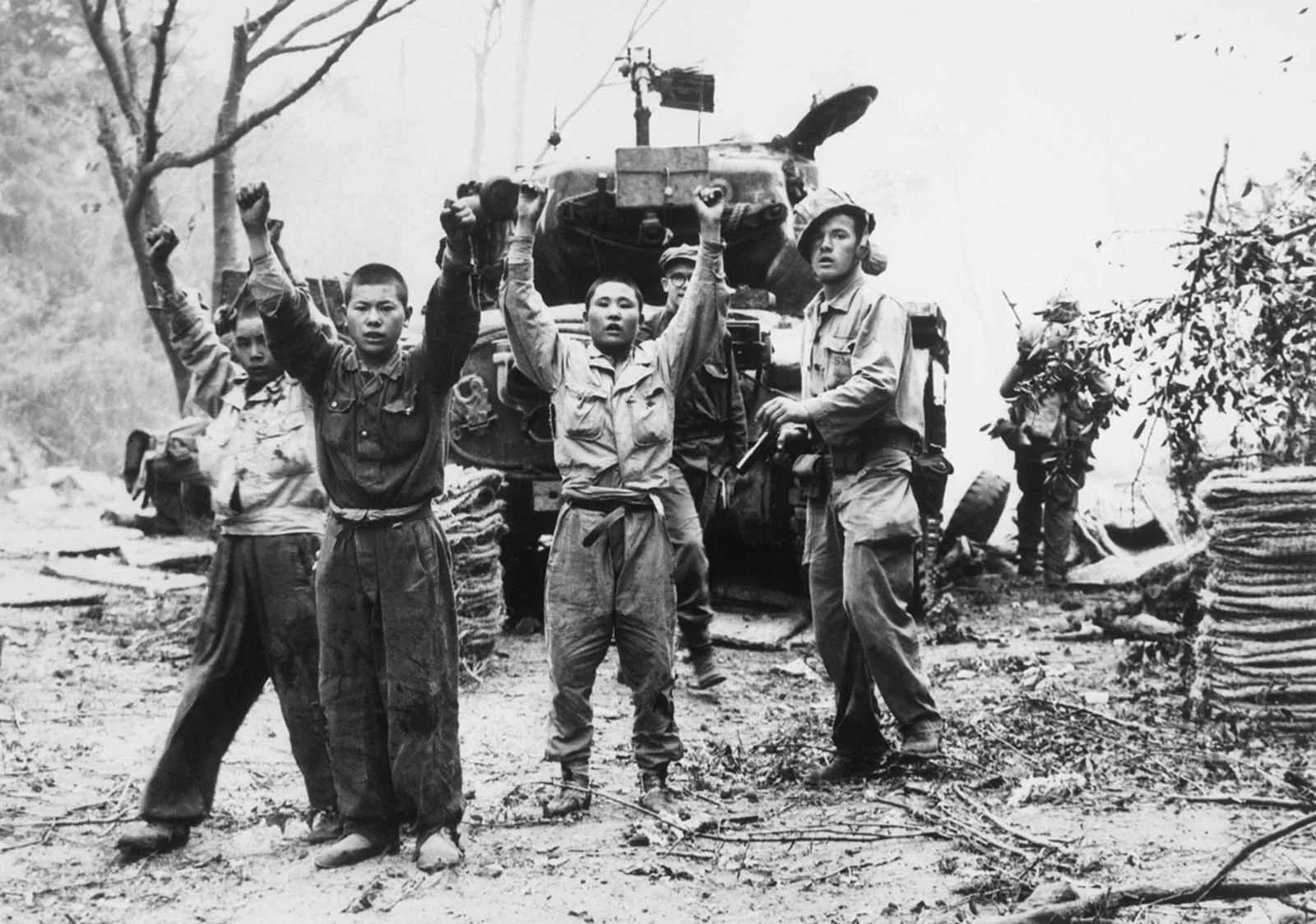
After World War II, Korea was divided along the 38th parallel as Soviet forces occupied the north and American forces occupied the south following Japan’s surrender. Two separate governments emerged: a communist regime in the north and an anti-communist government in the south. Tensions increased as both sides claimed to represent all Korea. In 1950, North Korean forces invaded South Korea, aiming to reunify the country under communist rule, triggering the Korean War and drawing in Cold War superpowers.
During the Korean War, the United States supported South Korea by sending troops, weapons, and leading United Nations forces to stop the spread of communism. When UN forces pushed toward the Chinese border, China entered the war in late 1950, sending large numbers of troops to support North Korea.
Source comparison. The Korean War
Source 1. Radio Report to the American People on Korea and on U.S. Policy in the Far East 1951.
US President Truman addressing the nation about the Korean War.
‘Our aim is to avoid the spread of the conflict.
The course we have been following is the one best calculated to avoid an all-out war. It is the course consistent with our obligation to do all we can to maintain international peace and security.
First of all, it is clear that our efforts in Korea can blunt the will of the Chinese Communists to continue the struggle. The United Nations forces have put up a tremendous fight in Korea and have inflicted very heavy casualties on the enemy. Our forces are stronger now than they have been before. These are plain facts which may discourage the Chinese Communists from continuing their attack.’
Source 2. China’s Road to the Korean War. Chen Jian. 1996
“China’s intervention in Korea was primarily defensive. Chinese leaders feared encirclement by hostile powers and believed that allowing American troops on their border would threaten the survival of the new communist state. Mao stated that ‘If the Americans advance to the Yalu River, we cannot stand idly by.”
Todo: questions
Use evidence from both sources to contrast the views of the American and Chinese leaderships. (4)
Belair Bugle article. The Korean War.
To do: Write a Belair Bugle article about the Korean War from one of the following perspectives
Choose one perspective:
American official
Chinese official
Korean civilian
Australian soldier
Include the following in your article (Remember to stay in character):
What is happening in the Korean conflict?
Why it is happening now?
Who is affected by the conflict?
5. Iran 1953
On Aug. 19, 1953, elements inside Iran organised and funded by the CIA and British intelligence services carried out a coup d’état that overthrew the elected government of Prime Minister Mohammed Mossadegh. They installed a Shah (kind of like a king) who was deeply unpopular among much of the population, the Shah relied on U.S. support to remain in power until his overthrow in 1979.
Historians have suggested the following reasons US covert action in Iran.
Fears that that political instability would lead to communist rule in Iran
A desire to control Iran's oil
Growing fears of a “collapse” in Iran, as policymakers believed that Iran could not survive without an agreement that would restart the flow of oil. (Declassified documents suggest this was a primary concern).
According to historian Ervand Abrahamian, Mossadegh’s nationalisation of the oil industry in 1953, was seen as a grave risk to Western domination of global oil supplies, particularly the oil concessions held by major Western oil companies in Saudi Arabia, Kuwait, Iraq, Venezuela, and elsewhere.
The U.S. and UK pressured the Shah to sign the Consortium Agreement 1954, which gave U.S., British, and French oil companies 40 percent ownership of the nationalised oil industry for twenty five years.
Fun Fact: “Atoms for Peace”
Iran was included in the US initiative, under which developing countries receive nuclear education and technology from the US. The United States provided Iran with a reactor and weapons grade enriched uranium fuel, laying the foundation for the country’s nuclear program.
They call that irony.
To Do: Use four sources to explore how oil shaped Iranian politics after 1949.
Summary of Iranian politics after 1949.
The strategic aims of the western bloc in Iran.
The strategic aims of the Soviet bloc in Iran.
Is there evidence for the role played by the CIA in the coup that toppled the Mossadegh government?

6. The Suez Crisis 1956
Background briefing: Egypt gains independence
Britain gradually relinquished control of Egypt between 1922 and 1956. In 1922, Britain ended its protectorate and declared Egypt independent, but retained control over defence, foreign affairs, the Suez Canal, and Sudan. British influence continued under the 1936 Anglo-Egyptian Treaty, which allowed British troops to remain in the Suez Canal Zone.
In 1949, Egypt and the other Arab nations were defeated by Israel. Within the army and wider Egyptian society, there was resentment, shock and dismay. There were scandals over the inferior equipment issued to the military, the king and government were blamed for treacherously abandoning the army.
An Egyptian commander who served in the war was Gamal Abdul Nasser, he commanded an army unit in Palestine and was wounded in the chest. Nasser was dismayed by the inefficiency and lack of preparation of the army. He felt betrayed by the Egyptian Royal family and the government.
He and other army officers staged a coup in 1952 and formed a nationalist Egyptian government that achieved (amongst other useful things) the following:
Ended the constitutional monarchy
Ended the British occupation
Ushered in a period of revolutionary politics in the Arab world
The Suez Crisis
On July 26, 1956, Egyptian President Gamal Abdel Nasser announced the nationalisation of the Suez Canal Company in response to months of mounting political tensions between Egypt, Britain, and France, including the cancellation of loans for the construction of the Aswan Dam.
Fun fact:
The Suez Canal allows trade between the Indian Ocean and Pacific Ocean to avoid the lengthy and often dangerous voyage around the bottom of Africa (Cape Horn).
The joint British-French enterprise that owned and operated the Suez Canal was outraged. Although Nasser offered full economic compensation for the Company, the British and French Governments, long suspicious of Nasser’s opposition to the continuation of their political influence in the region, made plans for a military intervention.
Nasser resented what he saw as European efforts to perpetuate their colonial domination.
On 29 October 1956, Israeli forces took the Sinai Peninsula, a strategic area for the protection of the Jewish State on its South Western border.
One week later, Anglo-French troops disembarked in Port Said. The operation was entirely successful — the Egyptian army was defeated in a few days, even though Nasser had ordered the sinking of some forty ships in order to block the Suez Canal completely.
However their successes would be short lived, the USA and the USSR had other plans and a new agenda for the Middle East.
To do: Nasser in 4 sources.
Use the primary and secondary sources to describe how the Suez crisis signalled the end of European Imperial influence in the Middle East.
What role did the Aswan Dam construction plans play in Nasser nationalising the canal and what did this act lead to? (Source 1.)
What was the role of the Soviet Union in the lead up to these events? (Source 2.)
How did the USA respond to the British and French actions in the Suez crisis? (Source 3.)
Why do some historians consider this event the end of European influence in the Middle East? (Source 4.)
The Suez Canal
6. Sources. Superpowers in the Middle East
Sources Analysis Answer Guide
Don’t forget: Quote often and begin your response with name of the author, not the Source number. Put the source number in brackets at the end of the quote/paraphrasing.
For example:
This is supported by Jones who states that 'History students would be more popular at parties if they used this method.' (Source 3)
More successful responses:
contain relevant evidence (quotes and observations) from sources when required.
Less successful responses
provide responses without reference to any evidence from the source
state that sources are limited without explaining why using evidence
do not assess the nature of sources clearly
do not explain how the nature and origin of the sources are a strength or limitation
do not include the source in the response.
Source 1. Increasing Soviet influence in the Middle East. THE MEI Institute.
‘Soviet gains in the Middle East were particularly threatening. Moscow’s arms deals with Nasser’s Egypt had led to rapidly expanding influence across the region at a time when Middle East petroleum resources were increasingly critical to the West. The Suez Crisis and the massive influx of Soviet arms and advisors into the region led to President Dwight Eisenhower’s commitment to defend the Middle East from Soviet aggression, the so-called “Eisenhower Doctrine. However the Suez and its aftermath created a strong sense that the region would succumb to Soviet-backed radical secular nationalism and that Egypt’s Nasser was “the wave of the future.” It was in this environment that the pro-Western government in Iraq collapsed in 1958. Iraq was now governed by radical, nationalist, leftist army officers whose primary organised support came from the powerful Iraqi Communist Party (CPI). Iraq transformed itself from a British colonial creation, client, and almost exclusive foreign policy issue to a fundamental American problem.
Questions
Use evidence from the source to explain the factors behind rising Soviet influence in the ME. (2)
What was the “Eisenhower Doctrine,” ? (2)
Why was the 1958 coup in Iraq a ‘fundamental American problem’? (2)
Source 2. The Kurds and the 1958 coup. globalsecurity.org
‘Kurds inhabit a mountainous region on the borders of Turkey, Iraq, Syria, Iran and Armenia, they are the second largest ethnic group in Iraq. Kurds had strongly supported the 1958 coup, Qasim had stipulated that the Kurds and the Arabs would be equal partners in the new state. Exiled Kurdish leaders, were allowed to return. Mutual suspicions, however, soon soured the relationship; by 1961, full-scale fighting broke out between Kurdish guerrillas and the Iraqi army. The army did not fare well against the seasoned Kurdish guerrillas, many of whom had deserted from the army. By the spring of 1962, Qasim's inability to contain the Kurdish insurrection had further eroded his base of power. The growing opposition was now in a position to plot his overthrow.
Questions
Why was Kurdish support important for the original success of the 1958 coup? (2)
How did the ‘soured relationship’ lead to political instability? (2)
How useful is a report like Source 2 for an historian studying the 1958 coup? (4)
Source 3: CIA Lists Provide Basis for Iraqi Bloodbath . [Al-Ahram, 27.9.1963]
According to historians Peter and Marion Sluglett, after the coup in Iraq in 1963, the CIA provided the coup leaders with lists of communists. More than ten thousand were killed and more than a hundred thousand were arrested in the bloody weeks that followed. Evidently, the CIA helped bring Saddam Hussein's thuggish party to power and fatally weakened the prospects for Iraqi democracy. King Husain of Jordan stated 'You tell me that American Intelligence was behind the 1957 events in Jordan. Permit me to tell you that I know for a certainty that what happened in Iraq on 8 February had the support of American Intelligence. Some of those who now rule in Baghdad do not know of this thing but I am aware of the truth. Numerous meetings were held between the Ba`ath party and American Intelligence, the more important in Kuwait. Do you know that . . . on 8 February a secret radio beamed to Iraq was supplying the men who pulled the coup with the names and addresses of the Communists there so that they could be arrested an executed.’
Questions
What role did the CIA play in the 1963 coup in Iraq? (2)
How does the information in Source 1 support US intelligence actions described in Source 3? (4)
Source 4. "Oil Sovereignty, American Foreign Policy, and the 1968 Coups in Iraq". Diplomacy & Statecraft. 2017
After the 1968 coup, the Arif government signed a major oil deal with the Soviets, the new government’s rapid moves to improve relations with Moscow were not a complete shock to U.S. policymakers, but they "provided a glimpse at a strategic alliance that would soon emerge’. Iraq also attempted to open a discreet line of communication with the U.S. government through a representative of the American oil company Mobil, but this overture was rebuffed by the Johnson administration as it had come to perceive the Ba'ath Party, in both Iraq and Syria, as too closely associated with the Soviet Union. In December, Iraqi troops based in Jordan began shelling Israeli settlers in the Jordan Valley, which led to a strong response by the Israeli Air Force.
Questions
How did the new Baathist government attempt to communicate with the US government after the 1968 coup? (1)
Use (all of the) sources to charecterise superpower actions in the ME after WW2. (4)
7. Indonesia 1965-1966
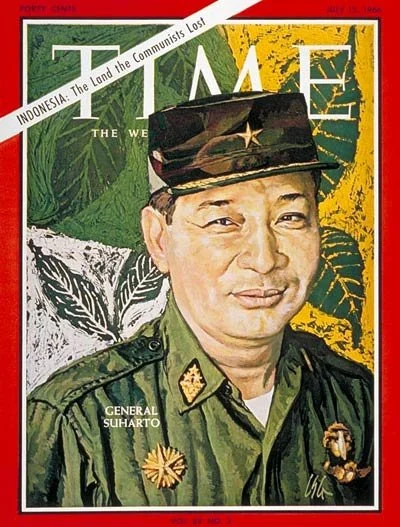
After a failed coup in September 1965 the Indonesian army, led by Suharto, accused the Indonesian Communist Party of attempting to seize power from President Sukarno. Violence spread across Indonesia, with the military, militias, and civilians targeting suspected PKI (Communist) members. Between 500,000 and one million people were killed.
The PKI was destroyed, Suharto gradually removed Sukarno (The Indonesian president who was supported by the Communist Party), and Indonesia became closely aligned with Western powers during the Cold War.
Source. Memorandum From Secretary of State Rusk to President Johnson. Washington, August 1, 1966.
‘Our traditional interest in Indonesia has been to keep the country out of the hands of its domestic Communists and out of the orbit of Communist China. This objective has, through the events of October 1 and their aftermath, for the time being been achieved. While protecting these major gains, our objective now is to help this populous, potentially rich and strategically placed nation—hitherto a disruptive force in Southeast Asia—overcome the inheritance of Sukarno’s mismanagement, develop an effective government, and become a constructive force in the area.
We share these objectives with many of our friends. The economies of Japan and Indonesia are complementary, and Japan wishes to play a leading role in helping the Indonesian economy get back on its feet. The trading nations of Western Europe are also attracted by Indonesia’s natural resources and the potential market of 100 million people.’
The role of the USA
Historians generally argue that the United States played a supporting but significant role in the destruction of the Indonesian Communist Party during the Indonesian mass killings of 1965–66.
Geoffrey Robinson argues that the United States encouraged and supported the Indonesian army, seeing the destruction of the PKI as a major Cold War victory.
Bradley Simpson suggests the United States provided political backing, intelligence, and diplomatic support, helping General Suharto consolidate power.
John Roosa argues that while the killings were mainly carried out by Indonesians, Cold War pressure and US support created conditions that made the purge more likely.
Questions
Use examples to describe what happened in Indonesia in 1965.
How do historians describe the the Cold War influence on these events?
Why did the USA support anti-communist forces in Indonesia?
What were the consequences for Indonesia after 1965?
Why is this event sometimes described as a "Cold War conflict"?
8. Cambodia and the Killing Fields
Source. Message From the President of the United States to the King of Cambodia, October 2, 1954
YOUR MAJESTY: The people of the United States have watched with concern and admiration the struggle of Cambodia against unwarranted Communist aggression. The United States is happy that Cambodia has reaffirmed its independence and that your Kingdom is in a position now to undertake a course which will secure that sovereign freedom for which your people fought.
At this time when Cambodia has so convincingly demonstrated its independence and its stern determination to maintain that independence, I desire Your Majesty to know that my Government will be pleased to consider ways in which our two countries can more effectively cooperate in the joint task of stemming the threats facing your territories and maintaining peace and prosperity in your Kingdom.
With assurances of my personal esteem and high regard.
Source 1: Questions
What is the value of Source 1. for an historian studying American government policy in Asia between 1950 and 1975? Refer to both the content of the source and its origin in your answer
How does the President's letter in 1954 support and contradict the secret Bombing of Cambodia.
The secret bombing of Cambodia. 1965 - 73
The Ho Chi Minh Trail was a vast network of jungle paths and roads running from North Vietnam through Laos and Cambodia to South Vietnam. It was a crucial supply route for North Vietnamese forces, allowing them to transport troops, weapons, and supplies
In response the US began Operation Menu. A massive bombing campaign in Cambodia and Laos.
Between 1965 and 1973, the American air force dropped nearly three million tonnes of bombs on Cambodia at 113,716 sites. To put this in perspective, the Allies dropped 2 million tonnes in all of WW2, including Hiroshima and Nagasaki. Cambodia may be the most bombed country in history.
The Americans were trying to prevent the Vietnamese supplying the insurgency in South Vietnam from the Ho Chi Minh trail.
Not very fun fact: The scale of the bombing and the resulting devastation and social dislocation is linked to the rise of the Khmer Rouge who had limited support before the war.
Sites bombed by US in Cambodia 1965 - 73
To do: Write an article that explain the secret bombing of Laos and Cambodia and the devastating impacts on both countries in the years afterwards.
Address the following points in your article.
What were the strategic objectives of the bombing campaign in Laos and Cambodia?
Include an annotated satellite image/map of the US bombing campaign in Cambodia using the link above.
Why do some historians link the secret bombing campaign to the rise of the Khmer Rouge and the fall of the Lao monarchy?
Explain the domestic reasons the US government kept the bombing campaign secret.
9. DIY Cold War source analysis
DIY decolonisation source analysis
Develop a source analysis that examines the Cold War.
Use the following outline for your source analysis.
Questions
Use evidence from the source to describe … (2)
Is Source 2 a primary or a secondary source? Use evidence to explain your answer. (2)
Use evidence from Source 3 to describe what is happening in this image (Cartoon / photo / poster)
Examine Source 4. With reference to the origin and nature of the source, assess the strengths and limitations of the source for historians investigating decolonisation in Africa. (4)
To what extent does the information in Source 5 support the information in Source 6? Justify your answer with evidence from each source. (4)
With reference to all of the sources evaluate the following proposition. (6)
Note. Ensure that you use a range of sources, both primary and secondary.
For example:
Source 4. "Oil Sovereignty, American Foreign Policy, and the 1968 Coups in Iraq". Diplomacy & Statecraft. 2017
After the 1968 coup, the Arif government signed a major oil deal with the Soviets, the new government’s rapid moves to improve relations with Moscow were not a complete shock to U.S. policymakers, but they "provided a glimpse at a strategic alliance that would soon emerge’. Iraq also attempted to open a discreet line of communication with the U.S. government through a representative of the American oil company Mobil, but this overture was rebuffed by the Johnson administration as it had come to perceive the Ba'ath Party, in both Iraq and Syria, as too closely associated with the Soviet Union. In December, Iraqi troops based in Jordan began shelling Israeli settlers in the Jordan Valley, which led to a strong response by the Israeli Air Force.
Question
Use information from the source to describe the reason the Johnson administration rebuffed Iraqi attempts at communication. (2