
Task 1. The First Australians
Research Deep Time History - The first Australians.
In this source analysis task you will examine different historical views about Aboriginal Australians’ farming practices and the building of semi-permanent homes. Using selected excerpts from Dark Emu and other sources, you will compare perspectives, assess evidence, and consider how interpretations of the past can change over time.
Part 1. Research
Why did the First Australians rapidly spread across the Australian continent and how did this influence the diversity of their cultures?
How did the geography and natural features of the landscape shape the lifestyle of First Australians?
How did First Australians’ deep connection to Country and Place shape their lifestyle and cultural practices?
Part 2. Were the First Australians the first bakers?
Use evidence from the three sources below and your own historical reasoning. Make sure you considerthe perspective, purpose and context of each author.
How might the invention of baking have impacted the daily life of First Australians? Consider social, cultural and economic impacts.
What are two conclusions from Journal of an expedition (source 1) about the extent of Aboriginal farming?
What argument is the excerpt from Dark Emu (Source 2) making about Aboriginal farming?
Use evidence from both sources to explain how the perspective of Pascoe (Source 2) differs from Sutton (Source 3). Which factors might shape their interpretations?
Source 1. Journal of an expedition to tropical Australia. T. Mitchell. 1848 (Early explorer)
‘the seed is made by the natives into a kind of paste or bread. Dry heaps of this grass, that have been expressly collected for this purpose, lay along the path for many miles. I counted 9 miles along the river in which we rode, with the grass reaching to our saddles’.
Source 2. Dark Emu. Bruce Pascoe. 2014
Bruce Pascoe is an Aboriginal artist and historian who is famous for his claims about Aboriginal farming practices
‘She swept her hands through the grass heads at Cuddie Springs. She glanced down at what she had gathered and walked back to the camp wondering. She looked around, gathered two stones and ground the seeds into powder. She probably tasted it later in the day, mixed it with water and baked it in the fire.
She made bread. 65 000 years ago. 13000 years before the Egyptians.
The woman came up with an idea far more important to humanity than the moon landing. That’s genius isn’t it?’
Source 3. Farmers or Hunter-Gatherers?. Peter Sutton & K Walshe (2021 )
(Peter Sutton, Anthropologist and linguist of Aboriginal culture has been critical of Pascoe’s book, Dark Emu)
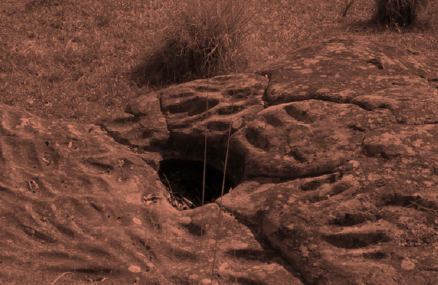
"Use of millstones for grinding seeds was adopted through much of Australia and nearby beginning somewhere around 4000 years ago. This was a significant shift in technology that occurred after about 46,000 years of occupation of the continent. Grindstone mythology is rich in certain regions, such as the Flinders Ranges— Simpson Desert area. There the Grinding Stone Men travel for ceremonies. The economic practice of seed grinding certainly had importance in that region. Dark Emu bypasses the evidence of seed grinding, exaggerates it and instead makes the claim that they were the world's 'first bakers". Grinding seeds doesn't mean they were bakers.'
Source 4. Aboriginal grinding stone.
Part 3. Did the First Australians live in permanent houses?
Use evidence from the four sources below and your own historical reasoning to answer the questions. Make sure you identify the perspective, purpose and context of each author.
How would a move into permanent houses impact the daily life of the First Australians? Consider social, cultural and economic impacts.
What argument is the excerpt from Dark Emu (Source 5) making about the significance of permanent housing? How is this relevant to the concept of terra nullius
Explain the bias of the 3 authors represented here. Pascoe, Mitchell & Andrews. How are they different form one another
Use evidence from both sources to explain how Source 5 (Pascoe) supports Source 6 (Andrews)
Does source 8 (Torres Strait islander architecture) support sources 5, 6 and 7. Explain your answer using evidence from each source.
Source 5. Dark Emu. Bruce Pascoe. 2014.
‘Before the British claimed Australia as their territory, they declared it terra nullius — which means 'land belonging to no one'. Although they knew Aboriginal people lived here, the British argued Australia was not settled because there was no evidence of houses, towns, roads or farms. Britain used this reasoning to claim Australia.
The common perception even today is that Aboriginal Australians were nomadic and lived in impermanent or moveable simple structures, which early settlers named 'humpies'. However, the explorers' diaries and journals are brimming with references to substantial Aboriginal housing across the continent — even those parts of Australia that today we think of as being harsh and difficult to live in. In his diaries, Thomas Mitchell (An English explorer) recorded his astonishment at entire villages of houses.’
Source 6. Journal of an expedition to tropical Australia. T. Mitchell. 1848 (Early explorer)
‘Some huts being large and circular, and made of straight rods meeting at an upright pole in the centre. The outside had been first covered with bark and grass and then covered with clay. The fire appeared to have been in the centre, with a hole in the top left as a chimney.’
Source 7. Andrews AEJ. 1986
‘After counting the houses. Mitchell estimated the population as over 1,000 people. He was disappointed that nobody was home — the evidence is that Aboriginal people had lived at this place for a very long time and had only just left. Mitchell described what we would call a village, which included large huts where people would gather. Some could accommodate up to 50 people. One of the party commented that buildings were ‘ of very large dimensions capable of containing at least 40 persons and of very superior construction’.
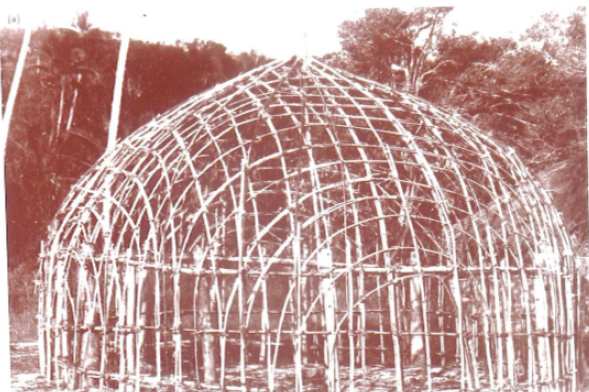
Source 8. Gunyah, goondie+ wurley: The Aboriginal architecture of Australia.
Memmott. P. 2007
A frame for house in the Torres Strait Islands
How to do a Sources Task
Sources Analysis Answer Guide
Hints and tips for a successful source analysis:
Quote often and begin your response with name of the author, not the Source number. Put the source number in brackets at the end of the quote/paraphrasing.
EG: ‘Lamb shows two examples of the importance of religion in Ancient Greece. ....' (Source 1)
Always use full sentences and include the question in your answer
Use the mark scheme to guide your answer.
Two marks means you need to make two clear points.
Three marks means you need to make three clear points.
For example:
This is supported by Jones who states that 'History students would be more popular at parties if they used this method.' (Source 3)