Vulnerable Cities
Introduction
As cities grow, weaknesses in housing, infrastructure, services, governance and planning can make some populations more vulnerable than others. These vulnerabilities become especially important when cities face hazards, natural events such as earthquakes and floods, or human induced hazards such as pollution, industrial accidents and infrastructure failures.
Background briefing: The problem with natural hazards.
A natural hazard is a naturally occurring event, such as an earthquake, flood, cyclone or bushfire, that has the potential to harm people, property, infrastructure or the environment.
To do: questions
Define a natural hazard
List the primary natural hazards
Background briefing: The problem with human hazards.
A human hazard is an event or process caused by human activity that can harm people or environments, including industrial accidents, pollution, conflict, nuclear disasters and infrastructure failures.
To do: questions
Define a human hazard
List examples of the primary human hazards
1. Vulnerability assessment
Background briefing: Vulnerability
The susceptibility of a community to a hazard or to the impacts of a hazard event
The vulnerability of a country or population can be indicated by levels of economic vulnerability. Vulnerability is the result of a range of demographic and socioeconomic factors that interact to affect the susceptibility of a people to the impact of a natural or human caused hazard. Levels of vulnerability vary from place to place and between different sections of society.
Vulnerable populations include the economically disadvantaged, racial and ethnic minorities, the uninsured, low-income children, the elderly, the homeless.
Why do hazards have greater impacts on some cities than others?
Some cities are more vulnerable because of poverty, weak governance, poor infrastructure, rapid growth and hazardous locations. Vulnerability assessments identify these weaknesses, helping cities prioritise planning, investment and adaptation.
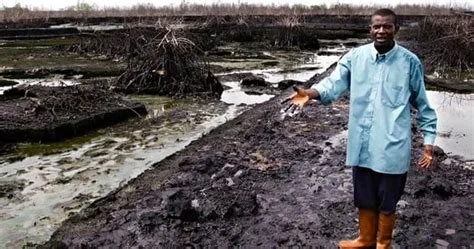
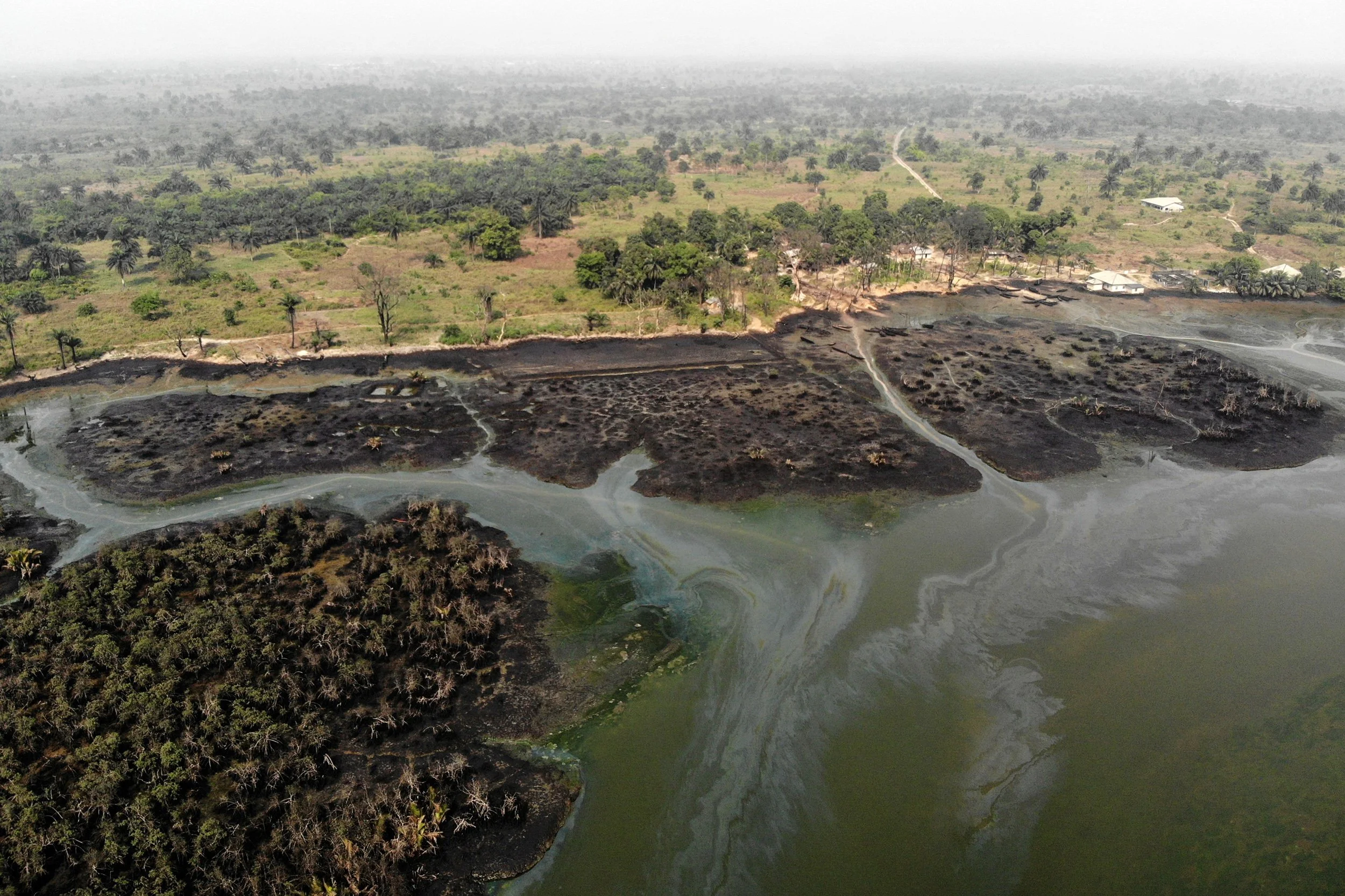
Oil spills, pipeline leaks and gas flaring have caused serious environmental damage in Nigeria, particularly in the Niger Delta. Oil pollution contaminates water and soils, damages fishing and farming livelihoods and threatens human health. This creates conflict between communities, governments and oil companies over responsibility, compensation and environmental restoration.
To do: Assess Nigeria’s vulnerability to hazards.
In this activity you will assess the factors that could result in a Nigerian hazard event becoming a disaster.
Source 1. Vulnerability
Vulnerability is the result of a range of demographic and socioeconomic factors that combine to affect the susceptibility of a people to the impact of a natural hazard. Levels of vulnerability vary from place to place and between different sections of society.
Vulnerability: The susceptibility of a community to a hazard or to the impacts of a hazard event
The vulnerability of a country or population can be indicated by levels of social vulnerability.
Vulnerable populations include the economically disadvantaged, racial and ethnic minorities, the uninsured, low income children, the elderly, the homeless.
Questions: Vulnerability assessment
1. Describe the importance of assessing a populations vulnerability to hazards.
2. List the reasons why some populations are more vulnerable than others.
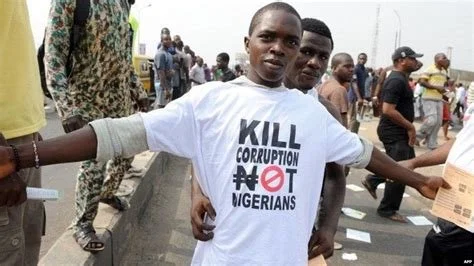
3. Explain how corruption would impact the vulnerability of a community.
Source 2. Nigerian vulnerability assessment - development indicators
Create a table that uses development indicators to describe levels of vulnerability in Nigeria.
Use a minimum of two annotated graphs to illustrate the state of development in Nigeria.
Annotate the table and the graphs to highlight areas of vulnerability.
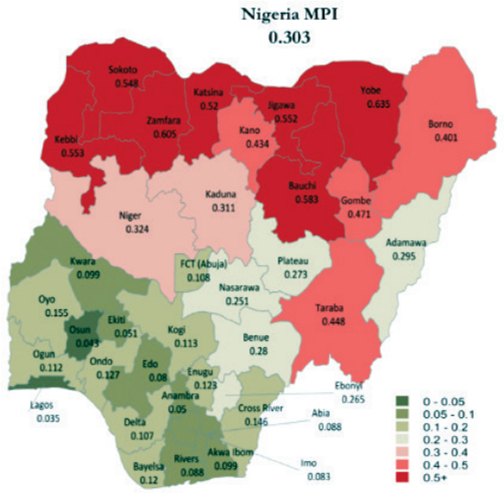
Source 3. Nigerian vulnerability assessment - MPI map
Note: The Multi-Dimensional Poverty Index (MPI) measures levels of poverty in a country.
A choropleth map provides a more detailed analysis of a country's status showing disparities between regions.
Poverty and the resulting vulnerability lead to hunger and malnutrition, limited access to education and other basic services, social discrimination and exclusion and also lack of participation in decision-making.
Questions
Briefly describe the purpose of the MPI.
Annotate a map of Nigerian population distribution.
Annotate the map of Nigerian MPI and identify the regions most vulnerable to Hazard events with reference to the .population distribution map.
Source 4. Regional development
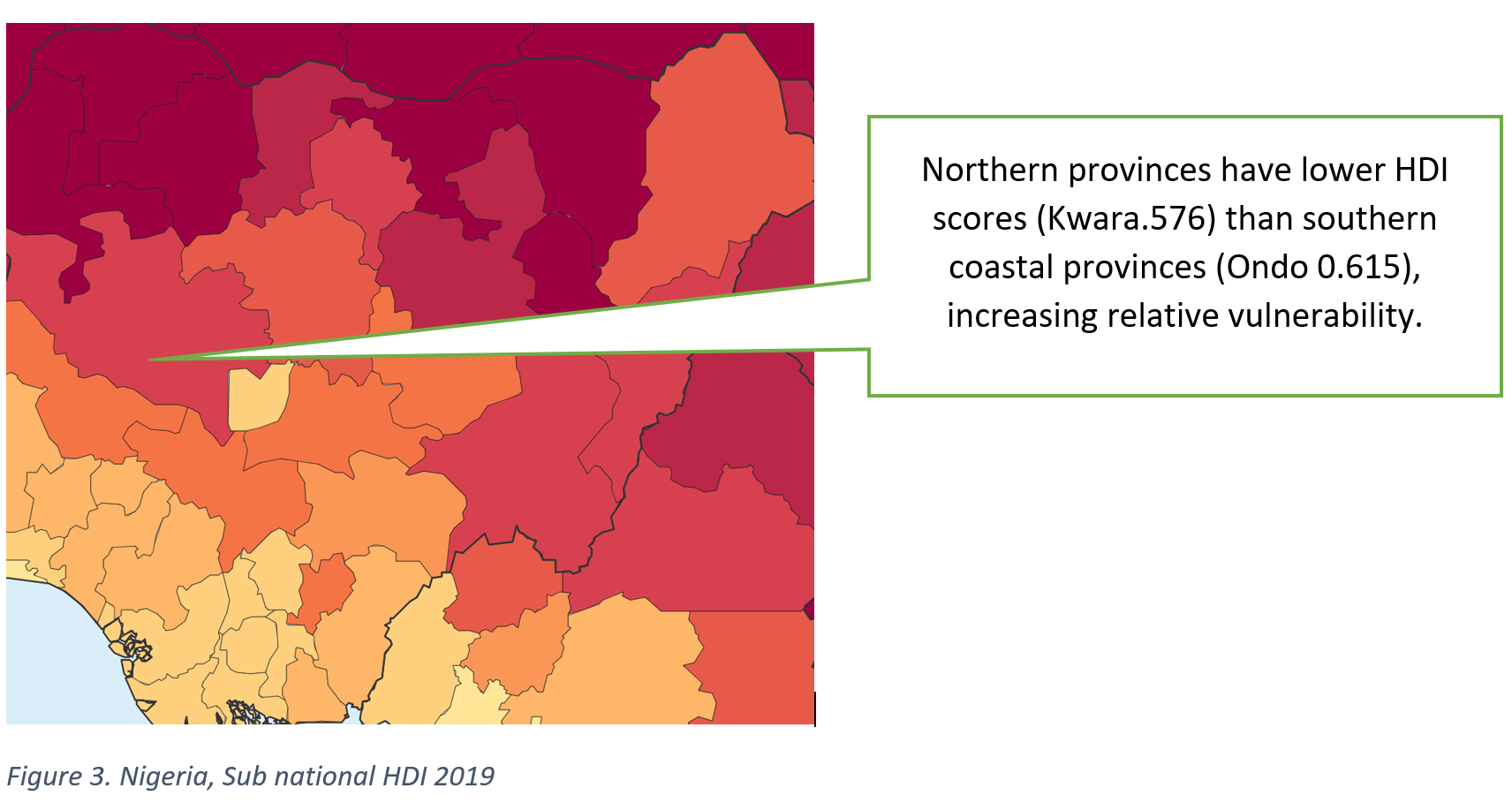
It is important to remember that disparities exist within countries.
In this example, the disparities in mean years of schooling in regional Nigeria.
Subnational Human Development Index (4.0) - Global Data Lab
Questions.
Use the subnational index to describe disparities within Nigeria using two (2) indicators.
Annotate the two maps and highlight any anomalies.
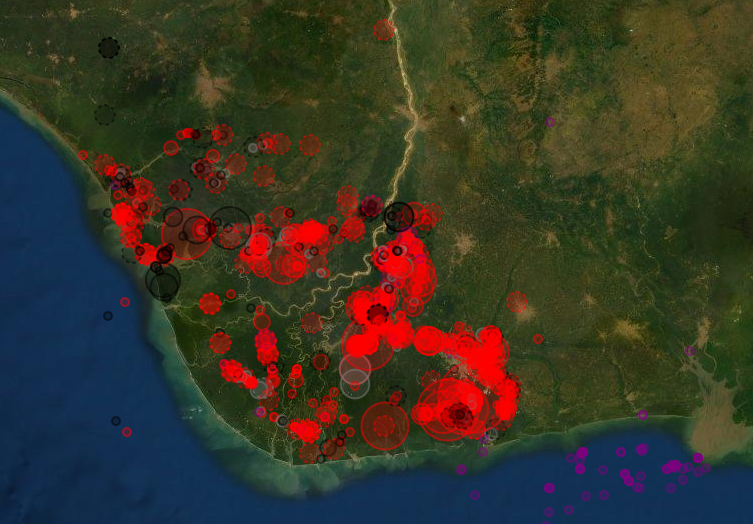
G skills: Mapping the spatial distribution of Nigerian oil spills with GIS.
We will use the GIS program: Nigerian Oil Spill Monitor Graphic
1. Go to the map menu
Change the incident date to >2010
Use an annotated image to describe the distribution of oil spills in Nigeria.
Extra: Use Google Earth to examine evidence of the impact of oil spills on human systems and the environment.
Source 5. Oil spills in the Niger Delta.
According to Amnesty International, Oil spills in Nigeria's Niger Delta have caused severe environmental damage and harmed local communities' health and livelihoods for decades. Shell has admitted to 1,693 spills and about 55.8 million litres of oil spilled since 2007 in the region.
This area is crucial for both its biodiversity and the livelihoods of millions who depend on farming and fishing.
Impact of Oil Spills (Mongabay)
Environmental Damage: Oil spills have led to the destruction of mangroves, polluted water sources, and loss of biodiversity.
Health Risks: Local communities suffer from health issues related to contaminated water and soil.
Economic Consequences: The spills have devastated local economies, particularly affecting agriculture and fishing.
Questions.
Annotate a map of Nigerian hydrology, highlighting area impacted by the oil spill hazard.
Use examples to describe the environmental impacts of oil spills in the delta.
Use examples to describe the economic impacts of oil spills in the delta.
Use examples to describe the social impacts of oil spills in the delta.
Source 6. Nigerian vulnerability assessment - Industrial facilities
Human hazards are generally (but not always) linked to industrial activity.
Find correlations with relative poverty levels from the MPI map in source 3 to make recommendations for planning.
Search term example 'Nigeria map location land use and economic activity'
Questions
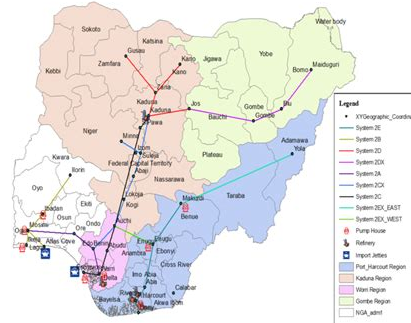
Annotate the map of Nigerian oil facilities and describe the regions at greatest risk of a Hazard event.
Use the Nigeria MPI map to identify the region's most vulnerable to hazard events as a result of poverty.
Source 7. Can Nigeria’s Oil Sector Be Saved? www.primebusiness.africa
The oil sector has long been Nigeria’s economic lifeblood, contributing the bulk of its foreign exchange earnings and government revenue. Yet, despite the nation’s immense crude oil reserves, the industry is riddled with corruption, mismanagement, and leadership failures.
The result is a sector that perpetuates fuel shortages, poverty, illegal bunkering, and rampant oil theft. These systemic issues have been dragging the industry backward, while other oil-producing nations make steady strides.The problems facing Nigeria’s oil sector are systemic and deeply entrenched.
Leadership failures, corruption, and poor governance have turned the sector into a liability rather than the economic powerhouse it could be. Unless drastic changes are made—beginning with an overhaul of NNPCL’s leadership and governance structure—Nigeria will continue to struggle with fuel shortages, oil theft, and financial mismanagement.
Question.
What does prime business identify as the main problems in Nigeria’s oil sector?
How might corruption and poor governance allow the oil pollution described in the earlier sources to continue?
How could oil pollution, fuel shortages and poverty combine to make communities more vulnerable?
Nigeria earns substantial revenue from oil. Explain how that wealth fails to help communities prepare for or recover from hazards?
GDP per capita
HDI score
Life expectancy (years)
Literacy rate %
Physicians per 1000 people
Corruption perception index
3. Vulnerable city - Port Au Prince, Haiti
Key question. Why did an earthquake become a catastrophe in Port-au-Prince?
Haiti was still rebuilding after Hurricane Gustav ravaged the island in 2008.
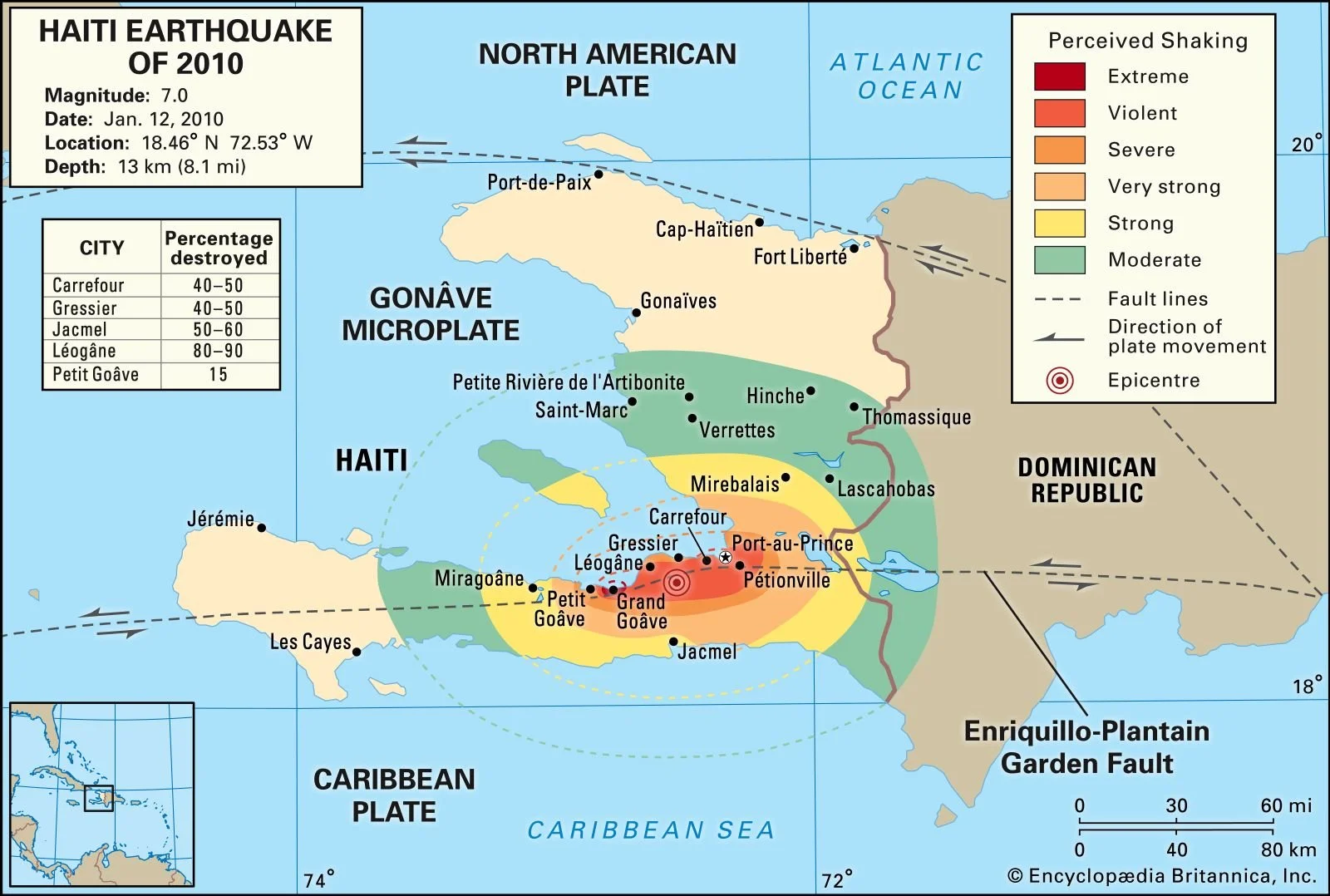
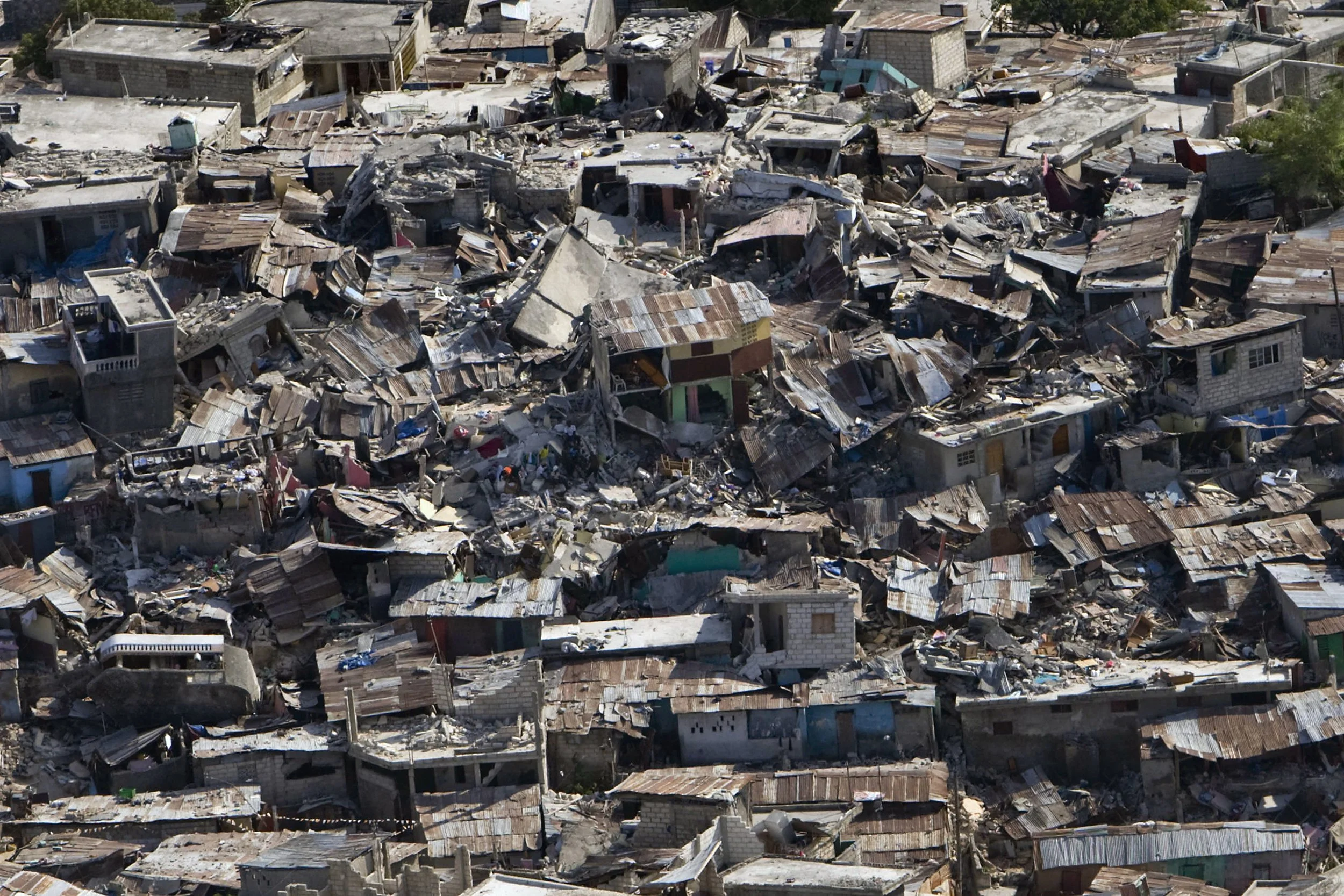
In 2010 a a magnitude 7.0 quake struck approximately 25 km WSW from Port-au-Prince at a depth of 13 km. Over 2 million Haitians live in Port au Prince and it is the most densely populated area of the country.
According to the World Bank, ‘Haiti remains the poorest country in the Latin America and the Caribbean (LAC) region and among the poorest countries in the world.’
A 2018 Global Competitiveness Report Index, measuring the quality of country institutions and the ensuing human capital and economic ecosystem, ranks Haiti second from the bottom out of 140 countries.
With a score of 16, Transparency International ranks Haiti 169 out of 182 countries.
An assessment of global earthquake fatalities over the past three decades (Nature 2011) indicates that 83 percent of all deaths caused by the collapse of buildings during earthquakes occurred in countries considered to be unusually corrupt.
Corrupt building practices, which are generally covert and hard to quantify, can include the use of substandard materials, poor assembly methods, the inappropriate placement of buildings and non-adherence to building codes, said the authors.
Answer the questions using evidence from the sources.
Source 1. Location
The earthquake was shallow and close to the capital. Local ground conditions also amplified shaking at some sites.
To do: questions
How did location influence the city’s exposure?
Source 2. Buildings
Many buildings performed poorly during the earthquake. Inadequate reinforcement, construction quality and structural design contributed to collapse.
To do: questions
Suggest reasons why buildings in Port au Prince were so badly damaged in the quake
Source 3. Corruption
A 7.0 magnitude earthquake that struck in New Zealand in 2010 resulted in zero fatalities.
An assessment of global earthquake fatalities over the past three decades (Nature 2011) indicates that 83 percent of all deaths caused by the collapse of buildings during earthquakes occurred in countries considered to be unusually corrupt.
To do: questions
How would corruption impact the quality of construction in Port au Prince?
Source 5. Disaster response
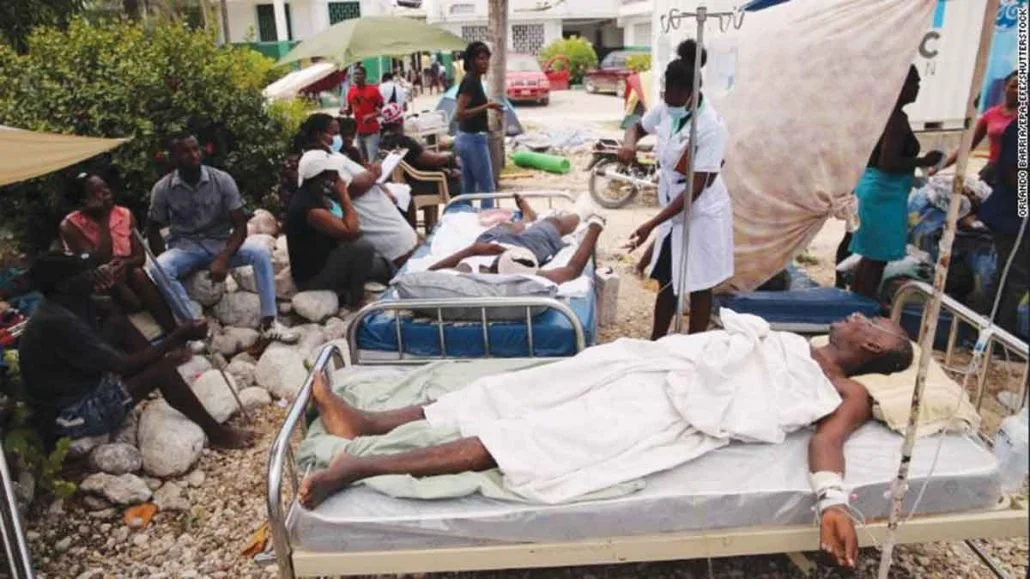
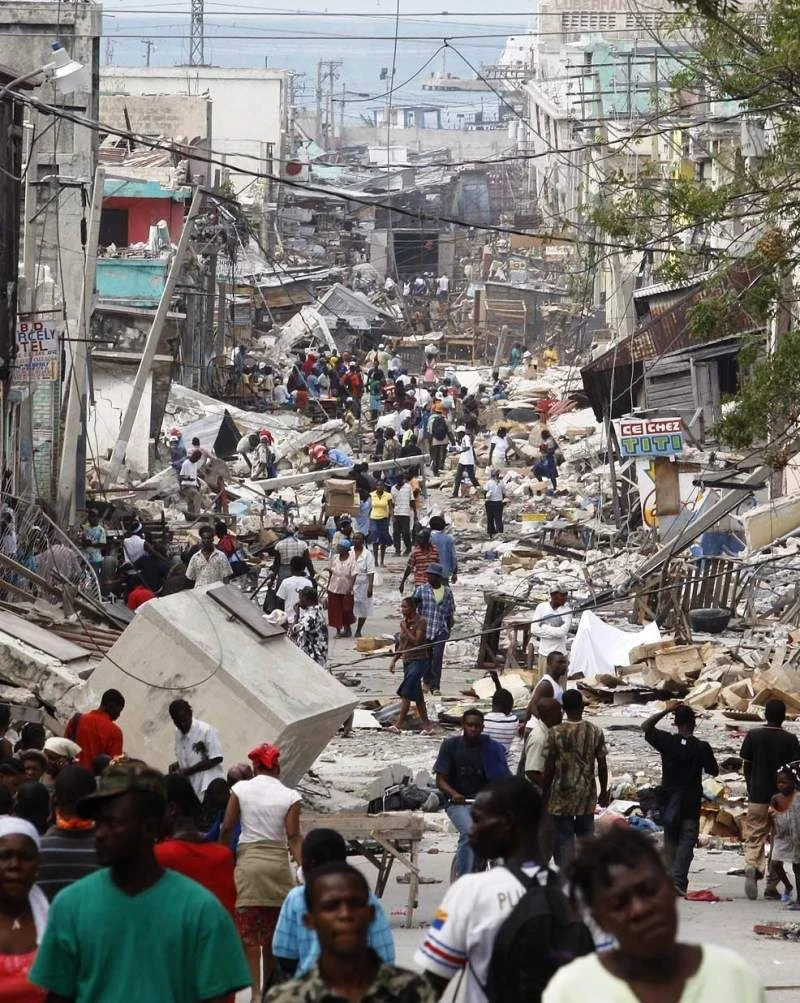
Haiti's establishments could not support recovery. The communication and transportation systems were down, hospital and electrical networks were too damaged to provide aid. Port-au-Prince's morgues could not accommodate the tens of thousands of deaths, leading to mass graves.
To do: questions
Use examples to explain how insecure and damaged infrastructure increases vulnerability to the impacts and after effects of disasters.
Source 4. Cholera outbreak
The UN sent humanitarian aid to support recovery, reconstruction and stability efforts for Haiti in response to the Earthquake. The peacekeepers incorrectly disposed of sewage near a UN camp, which ultimately spilled into the river. Reflecting an ongoing problem with a lack of sanitation facilities and access to fresh water. The sewage spill into the Mielle river, a main source of drinking water for many of the people in Haiti, became contaminated with Cholera which then caused an outbreak throughout Haiti causing the deaths of over 10 000 people
To do: questions
Explain the causes and impacts of the Cholera outbreak in Haiti.
Source 7. Corruption fears stalk Haiti after the quake. BBC. 2010
Institutions already faced limited capacity. Damage to government and service buildings further weakened the response.
Having lost thousands of civil servants and most of its buildings, Haiti's government admits it was overwhelmed trying to organise the disaster response between the UN, the international community and numerous aid agencies.
But with billions in aid coming into the country, the question of corruption is one it has had to address. The government says the lack of co-ordination over what is being spent where means the system is open to abuse.
Prime Minister Jean-Max Bellerive says: "The problem is I don't know who is receiving aid, what they are doing with it and where it goes, but it's important that the government knows, because we will be held accountable for it.
To do: questions
What happens when the organisations responsible for managing a disaster are themselves affected?
Extra: How did corruption impact the disaster response?
Source 8. Property rights and redevelopment
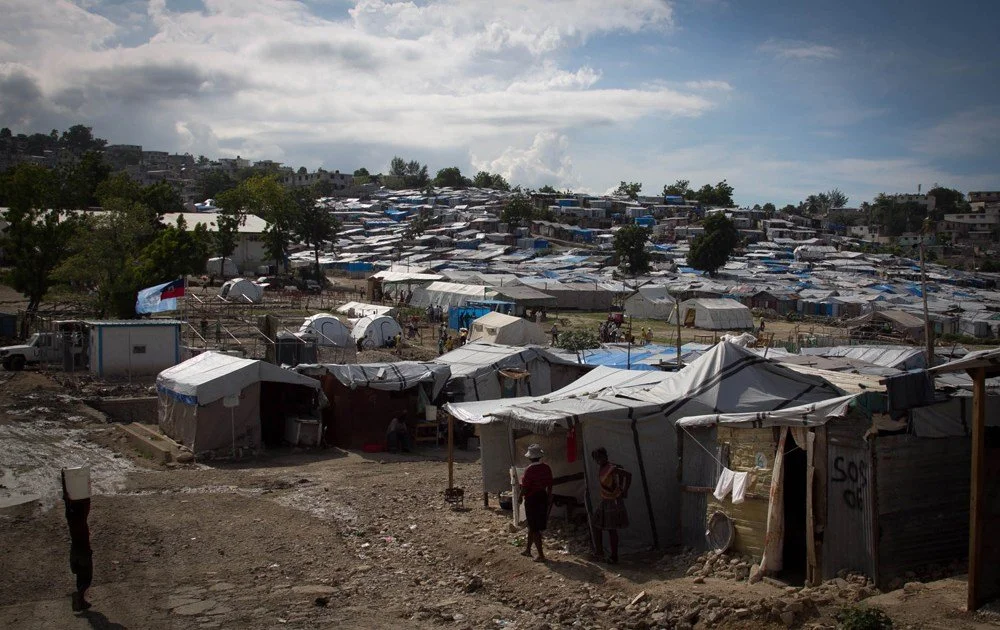
Lack of property rights and land and difficulties securing land complicated housing reconstruction.
To do: questions
Explain how providing aid and building materials have been insufficient to restore housing in Port au Prince.
Extra: Use five (5) examples to explain how interacting vulnerabilities turned the Haiti earthquake into a disaster.