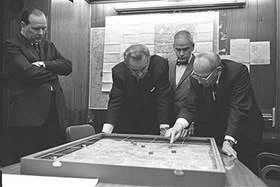
Vietnam 1966 - 1971
The Vietnam War began after Vietnam was divided in 1954 by the Geneva Accords.
Communist North Vietnam supported insurgents in the South (Viet Cong). The United States backed South Vietnam, fearing that a communist victory would spread across Asia under the “domino theory,” threatening American influence and allies in the region.
Initially, American efforts were aimed at supporting the South Vietnamese government with economic and military aid.
The Vietnamese call this conflict the American War.
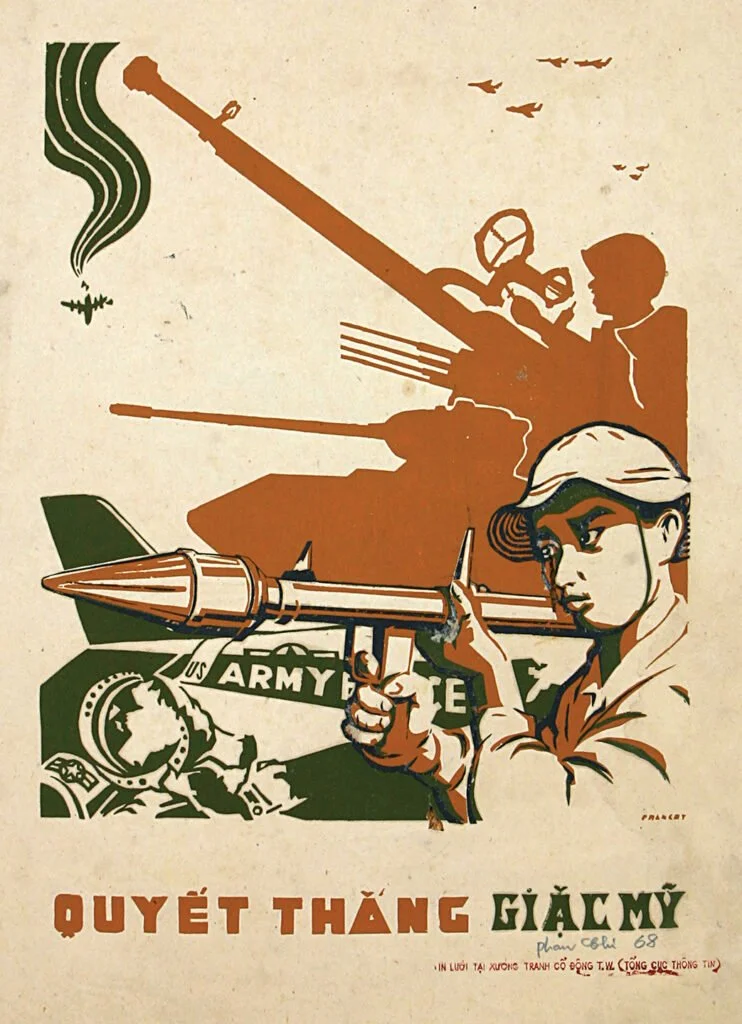
1. Sources - US involvement in South Vietnam
Sources Analysis Answer Guide
Don’t forget: Quote often and begin your response with name of the author, not the Source number. Put the source number in brackets at the end of the quote/paraphrasing.
For example:
This is supported by Jones who states that 'History students would be more popular at parties if they used this method.' (Source 3)
More successful responses:
contain relevant evidence (quotes and observations) from sources when required.
Less successful responses
provide responses without reference to any evidence from the source
state that sources are limited without explaining why using evidence
do not assess the nature of sources clearly
do not explain how the nature and origin of the sources are a strength or limitation
do not include the source in the response.
Source 1. President Eisenhower explains the Domino Theory. 1954.
You have broad considerations that follow from what you would call the falling of the Dominoes. First, you have the locality of resources that the world needs, now from this particular area you have tin, tungsten and of course the rubber plantations. Secondly, you have more people passing under Communist domination, Asia after all has already lost 450 million people to Communist dictatorship.’
Questions
1. What are two conclusions that can be drawn from the source about the US strategic approach to Vietnam. (2)
Source 2. The strategic hamlet approach. US State Department. 1962
‘The danger to South Vietnam comes from the infiltration of VC into the villages in rural South Vietnam. were they are building support. The recommended program to counteract these activities is modelled on the British approach to communist insurgents in Malaya. The local population will be concentrated into village strongholds and therefore separated form contact with the VC.’
Questions
2. Is source 2 a primary or a secondary source? Use evidence from the source to support your answer. (2)
Source 3. Hearts and Minds program. AWM.gov.au. Unknown photographer. 1965
Hearts and Minds (Vietnam) or winning hearts and minds refers to the strategy and programs used by the governments of South Vietnam and the United States during the Vietnam War to win the popular support of the Vietnamese people and to help defeat the Viet Cong insurgency.
Question
3. How is useful is the source for an historian studying the Hearst and Minds program in southern Vietnam. (4)
Source 4. The perils of dominance. G. Porter. 2005
‘The group of advisors in the Kennedy and Johnson administrations played a key role in escalating US involvement. Both presidents wanted to avoid military intervention and preferred to open peace negotiations with the DRV. But the hawkish advisers believed that military solutions would be more effective.
Source 5. President Lyndon Johnson at a White House meeting on November 24, 1963
‘ We do this [escalating U.S. military involvement in Vietnam] in order to slow down aggression. We do this to increase the confidence of the brave people of South Vietnam who have bravely born this brutal battle for so many years with so many casualties. And we do this to convince the leaders of North Vietnam—and all who seek to share their conquest—of a simple fact: We will not be defeated. We will not grow tired. We will not withdraw either openly or under the cloak of a meaningless agreement.
Questions
4. To what extent does the information in Source 4 support the information in Source 5? Justify your answer with evidence from each source. (4)
5. Evaluate the following statement with reference to all of the sources.
US actions in the lead up to the escalation after the Bay of Tonkin incident were focussed solely on military solutions to the threat of communist aggression.
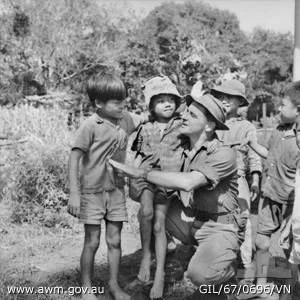
Source 3. Hearts and Minds
2. The American War in five paragraphs
Activity 1. The American War in 5 paragraphs.
We are going to write a paragraph about the war in five events that answers the following question.
Question: Was America’s war in Vietnam a noble struggle against Communist aggression, a tragic intervention in a civil conflict, or an attempt to crush a movement of national liberation?
How to write a beautiful paragraph
Topic sentence: Start with a clear and precise topic sentence that refers directly to the content of the paragraph. The topic sentence tells the reader what the paragraph is about, or its main idea
Explain: Explain what you mean in greater detail.
Evidence: Provide evidence to support your idea or claim. To do this, refer to your research. This may include: case studies, statistics, documentary evidence, academic books or journal articles.
Link: Summarise the main idea of the paragraph, and make clear how this paragraph supports your overall argument. The Second Indo China War in 6 Events.

Paragraph 1. The American motivations for military involvement.
America described the war in Vietnam a noble struggle against Communist aggression.
Critics call it a tragic intervention in a civil conflict and an attempt to crush an independence movement.
America’s leaders insisted that military force was necessary to defend a sovereign nation (South Vietnam) from Communist aggression. According to President Lyndon B. Johnson in 1965, “The first reality is that North Vietnam has attacked the independent nation of South Vietnam. Its object is total conquest.”
He warned that the Communists in Vietnam were supported and guided by the Soviet Union and China. Therefore, the war in South Vietnam was not an isolated, local conflict, it was part of America's highest priority, the Cold War struggle to contain Communism around the globe.
US Policymakers warned that if South Vietnam fell to Communism, neighbouring countries would inevitably fall in turn, one after another, like a row of dominoes.

Paragraph 2: The Gulf of Tonkin incident as cause and effect.
Did the US use a false flag operation as a justification for increasing its involvement in Vietnam?
Early 1964, South Vietnam began conducting U.S backed commando attacks and intelligence gathering missions along the North Vietnamese coast.
Success was limited so the US shifted the operation's tactics from commando attacks on land to shore bombardments using mortars, rockets, and rifles fired from South Vietnamese patrol boats. In response, North Vietnamese patrol torpedo boats attacked the USS Maddox in international waters in the Gulf of Tonkin.
Two days later, the US claimed that the Maddox had been attacked again. After the second attack, the U.S. Congress passed a resolution almost unanimously allowing the federal government to “take all necessary measures” to protect U.S. forces in Vietnam.
Fun fact: In 2005, declassified NSA documents showed that there was no second attack. U.S. officials had lied. This lie started a war that would claim 58,220 American and more than 3 million Vietnamese lives. ‘The overwhelming body of reports, if used, would have told the story that no attack occurred."
Paragraph 3: The Tet offensive. January 1968. War by other means.
“We have reached an important point where the end begins to come into view.” —General William C. Westmoreland speaking to the National Press Club on November 21, 1967
US forces win the battle. However North Vietnam wins the war for American public opinion.
Late January 1968. The beginning of the most sacred Vietnamese holiday. Communist forces launched a sweeping assault across South Vietnam.
Over 80,000 Vietcong troops emerged, seemingly from nowhere, to attack major metropolitan areas across South Vietnam. Surprise strikes were made at the American base at Danang and the American embassy in Saigon.
During the weeks that followed, the South Vietnamese army and U.S ground forces recaptured all of the lost territory, inflicting twice as many casualties on the Vietcong.
However, the media images changed the American publics view off the war. Government statements about the war being nearly over were clearly false. After three years of intense bombing, billions of dollars and 500,000 troops, the VC proved themselves capable of attacking anywhere they chose.
The message was simple, this war was not almost over.
The offensive shook the American military command and more importantly, the American home front.
“It became necessary to destroy the town to save it.” —AP correspondent Peter Arnett quoting a U.S. major on the decision to bomb and shell Ben Tre on February 7, 1968 after Viet Cong forces overran the city in the Mekong Delta forty-five miles south of Saigon during the Tet Offensive.
“We have been too often disappointed by the optimism of the American leaders, to have faith any longer in the silver linings they find in the darkest clouds… For it seems now more certain that the bloody experience of Vietnam is to end in stalemate.”
Walter Cronkite, American news anchor, February 1968
Paragraph 4. The My Lai Massacre. 1968.
The My Lai massacre was the mass murder of 506 unarmed civilians by American troops.
First hand account: Pham Thi Thuan had just woken up and was cooking potatoes when the Americans landed nearby and began killing her neighbours. The US soldiers had enter the area to kill local fighters. Military intelligence had determined that the villagers were harbouring Vietcong, although Thuan denied this was the case.
“They first killed the people at the rice paddies, as well as the cattle,” said Thuan, an 80-year-old rice farmer from Son My village.
“We just worked for ourselves,” she said. Only a handful of weapons were captured, and the only American casualty that day was a soldier who deliberately shot himself in the foot.
American soldiers treated all the villagers, including women and children, as hostile. One of them, Private Paul Meadlo, recounted what he had done in a 1969 interview for CBS News.
“You just spray the area on them and so you can’t know how many you killed ’cause they were going fast. So I might have killed 10 or 15 of them,” he told interviewer Mike Wallace.
“Men, women, and children?” asked Wallace.
“Men, women, and children,” he replied.
“And babies?”
“And babies.”

Paragraph 5: The Ho Chi Minh trail. Guerrilla warfare and unexpected consequences.
The Ho Chi Minh was not one trail but a series of trails. The trail was used by the Viet Minh as a route for its troops and supplies (Food, weapons and equipment) to get into the South.
US attempts to cut the trail lead to devastating outcomes.
The trail ran along the Laos/Cambodia and Vietnam borders and was dominated by jungles. In total, the ‘trail’ was about 1,000 kilometres long.
The ‘trail’ also included dummy routes that served to confuse the Americans. In places it was 80 kilometres wide. Up to 40,000 people were used to keep the route open.
The natural environment gave the trail excellent cover. The jungle tree canopy disguised what was going on at ground level.
The American response was extensive bombing and the use of defoliants (The most famous being Agent Orange) to kill vegetation that gave cover to those using the trail. Large areas of jungle were effectively killed off, but the trail remained in operation and was used for the duration of the war.
3. Comparing the strategies and tactics of the two sides.
The Americans and the North Vietnamese used very different strategies and tactics in the conflict.
Strategy is the overall plan used to achieve a long-term goal. It focuses on the big picture — what you want to achieve and how you intend to win.
Tactics are the specific actions or methods used to carry out that strategy. They are the smaller steps taken to make the larger plan work.
The Vietnam War provides a clear example of how different strategies and tactics can shape a conflict. The United States and South Vietnam relied on superior technology, firepower, and large-scale military operations. In contrast, North Vietnam and the Viet Cong used guerrilla warfare, local knowledge, and a strategy focused on wearing down their opponent over time.
In this activity, we will examine the strategies of both sides in the Vietnam War and identify the tactics they used to achieve their goals.
As Historians we can try to understand why each side chose to fight the war in the way they did.

Part 1. The US strategy and tactics in Vietnam.
Westmoreland's (US Commander) wider strategy was to wage a war of attrition. The goal was to inflict heavy damage on North Vietnam and the Viet Cong, to make it impossible for them to recover and keep fighting.
To achieve this, US tactics included a long series of small scale attacks to gradually wear down the enemy and extensive aerial bombingsin North Vietnam and Cambodia.
The ground strategy in South Vietnam was similar, devastate the Viet Cong and pro-communist forces. Key tactics of the ground war included search and destroy missions. Local intelligence was used to identify VC and pro-communist strongholds, then eliminate them with firepower. From 1966 to 1967, the United States poured troops into Vietnam, over 485,000 by the end of 1967, a clear sign that the US ground war was struggling.
Operation Rolling Thunder
The Vietnam War featured the most intense bombing campaign in military history and had massive human costs. General Westmoreland believed that the regular forces of the Viet Cong and the NVA would continue to suffer enormous casualties at the hands of massive U.S. firepower. Eventually, it was expected that the communists would no longer be able to replace their losses on the battlefield. Having been ground down on the battlefield, they would presumably agree to a favourable peace settlement.
Questions. US strategy
Outline using examples the wider US strategy in the war in Vietnam
Use examples to describe US tactics in Vietnam.
How did Operation Rolling Thunder reflect US strategy in Vietnam?
Research: What was the impact of Operation Rolling Thunder on Vietnamese civilian populations?

Operation Rolling Thunder
Part 2. The Viet Cong strategy
In 1965, Ho Chi Minh and the North Vietnamese leadership ordered a change in a way the war in the South was to be fought. From now on, the Vietcong would avoid pitched battles with the Americans unless the odds were clearly in their favour. There would be more Guerrilla style hit and run attacks and ambushes.
The Vietcong, also developed extensive tunnel systems that were training grounds, logistics centres and headquarters. They also offered secure sanctuaries for times when the war might go badly. The tunnels were fighting bases capable of providing continuous support for troops. Even if a village was in enemy hands, the NLF in the tunnels were still able to conduct offensive operations.
Giap's Guerrilla Strategy
General Giap (Chief North Vietnamese strategist) was the master of doing the unexpected. He played on the Western powers' belief that firepower alone determined victory. Their overconfidence and hubris was their downfall.
General Giap’s unconventional tactics
Win over the peasantry, avoid damage to the land, crops, houses. Help them in work
Night attacks and booby traps made with bamboo sticks, called punji sticks, and filled with faeces to ensure infection, increasing the chances of death.
Write reports and publish after firefights to improve performance.
Use specially trained sappers to attack enemy defensive positions by placing demolition charges, using hand grenades and RPG's to disrupt enemy positions.
Attacks were swift and unexpected, they were able to damage key American bases and the American’s morale.
Secret supply lines and paths, based on ancient footpaths through the jungles on the borders between Vietnam, Laos and Cambodia, known to Americans as the Ho Chi Minh Trail.
Questions. Vietnamese strategy
Why do you think the Viet Cong changed their strategy early in the war with the US?
How did the Viet Cong use the tunnel system in the war?
‘General Giap was the master of doing the unexpected’. Use examples of his unconventional tactics to explain what is meant by this statement.
“The enemy advances, we retreat; the enemy camps, we harass; the enemy tires, we attack; the enemy retreats, we pursue ”
Source 2. General Bruce Palmer Jnr
'So the challenge was bringing the enemy forces to battle, for they had no definite, recognisable or overt positions. They remained either ‘underground’ (often literally) within South Vietnamese borders, or back in base sanctuaries in Cambodia or Laos, going on the attack only when they so decided, seeking to surprise a preselected victim. Thus the enemy clearly had the initiative; and, given the way the United States had decided to fight the war in a passive defence of South Vietnam, American forces found themselves in the unenviable situation of having to react and dance to the enemy’s tune'.
Source 2. Questions.
What is the value of Source 2 for an historian studying the tactics of the Viet Cong in the Vietnam War?
Use evidence from Source 2 to describe the Viet Cong tactics in the Vietnam War.
4. War Room
Intelligence Briefing:
You are intelligence officers in the Australian military.
Your task is to brief the generals in the war room about the status of the conflict in Vietnam as the two sides move toward a negotiated peace.
Your briefing will inform Australia’s approach to the end of the war in Vietnam.
Briefing brief:
Create a Mind Map to explain the strategy and tactics of the two sides.
that Are the American tactics in Vietnam working.?
Are the N. Vietnamese losing? Explain the reasons for your position.
How are the peace movements in Western countries impacting the conduct of the war?
Extra: Is it in Australia’s long term interests to remain involved in the conflict?