Decolonisation
The end of European imperialism
After 1945, European empires were weakened by the devastation of the Second World War.
Anti-colonial movements gained strength, inspired by wartime promises of self-determination and the new role of the United Nations. India’s independence in 1947 set an early example, and conflicts in Indonesia and Vietnam signalled that imperial control could no longer be easily maintained.
The emerging Cold War between the United States and the Soviet Union made decolonising countries a new field for the competition, with both superpowers seeking influence over newly independent states. Independence movements were often shaped, supported, or destabilised by Cold War intervention, sometimes leading to proxy conflicts rather than stable self-government.
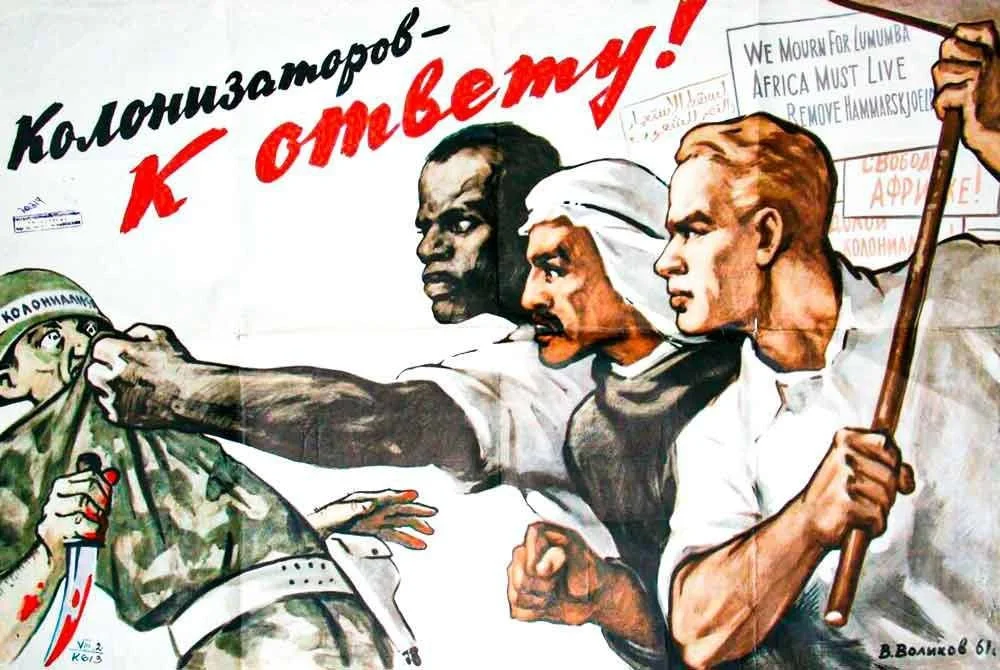
1. The end of the European empires
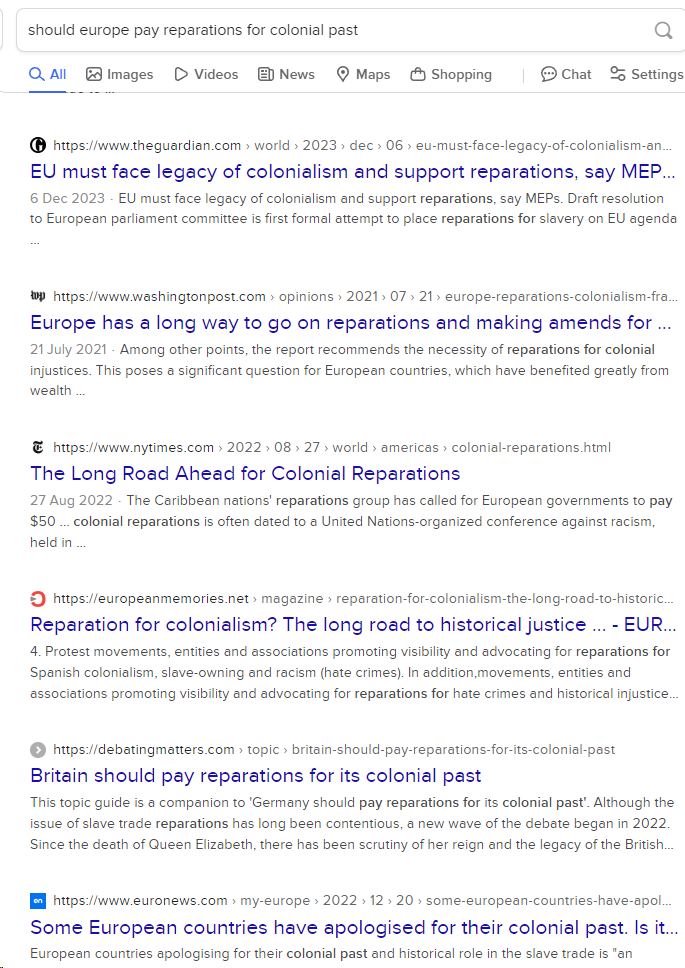
Decolonisation. The end of the European empires.
Key question: Why did the European empires begin to collapse after 1945?
Decolonisation refers to the process of the end of European colonial empires when former colonies gained independence after World War II.
6 factors that caused decolonisation after 1945:
1. World War II: The devastation of World War II weakened many colonial powers, making it difficult for them to maintain control over distant territories. The war also showed that there were contradictions in European colonialism, as European powers fought for freedom and self-determination while denying the same to their colonies.
2. Changing expectations: After the war the idea of self-determination became more popular as the UN Charter emphasised the rights of peoples to determine their own political status. This put pressure on colonial powers to grant independence to their colonies.
3. Economics: After the war, many colonial powers were broke and could not maintain expensive distant colonies. Also, colonies had often been economically exploited, and they demanded economic equity and control over resources
4. Rise of Nationalism: Colonised people began to assert their own identities and cultures through seeking self-governance and independence. They often mobilised mass protests, strikes, and other forms of resistance against colonial rule. Colonial powers including Britain, France, and the United States also had civil rights movements that wanted an end to inequality and injustice at home and in their colonies.
5. Education: As literacy rates increased and information became more accessible, people in colonised territories became more aware of the unjust nature of colonial rule.
6. The Cold War: The United States and the Soviet Union sought to gain influence over newly independent nations. The former colonial powers often granted independence to their colonies hoping to maintain their own alliances and influence.
To do: Introduction to Decolonisation
In your own words, briefly outline the primary reasons for the end of European colonisation after WW2.
Write a brief paragraph (100 words) in response to the following statement.
‘Decolonisation would have occurred without WW2.’
Explain the growing support for decolonisation after WW2 to me like I am five.
Background briefing: The end of European colonisation.
The end of the European colonial period in the mid 20th century reflected the economic exhaustion of the European powers and their resulting inability to respond to the new challenges of the post war period.
Colonial countries, inspired by leaders like Gandhi, pushed for independence through resistance and diplomacy. By the 1960s, many colonies had achieved independence, marking the conclusion of centuries long European domination across the globe.
Four step recipe for mismanaging the process of decolonisation.
Attempt to maintain control of your colony. (When you cannot afford it.)
Fight a war of independence (That you cannot win, even with better technology, armaments etc).
Start to lose the war, then seek a political solution. (That benefits you and your attempts to maintain control of your ex colony's resources and does not benefit the newly independent country).
Leave in disgrace. (With a legacy of mismanagement and an ex-colony facing an uncertain future as a new nation)
Discuss: Why did European powers resist the process of decolonisation?
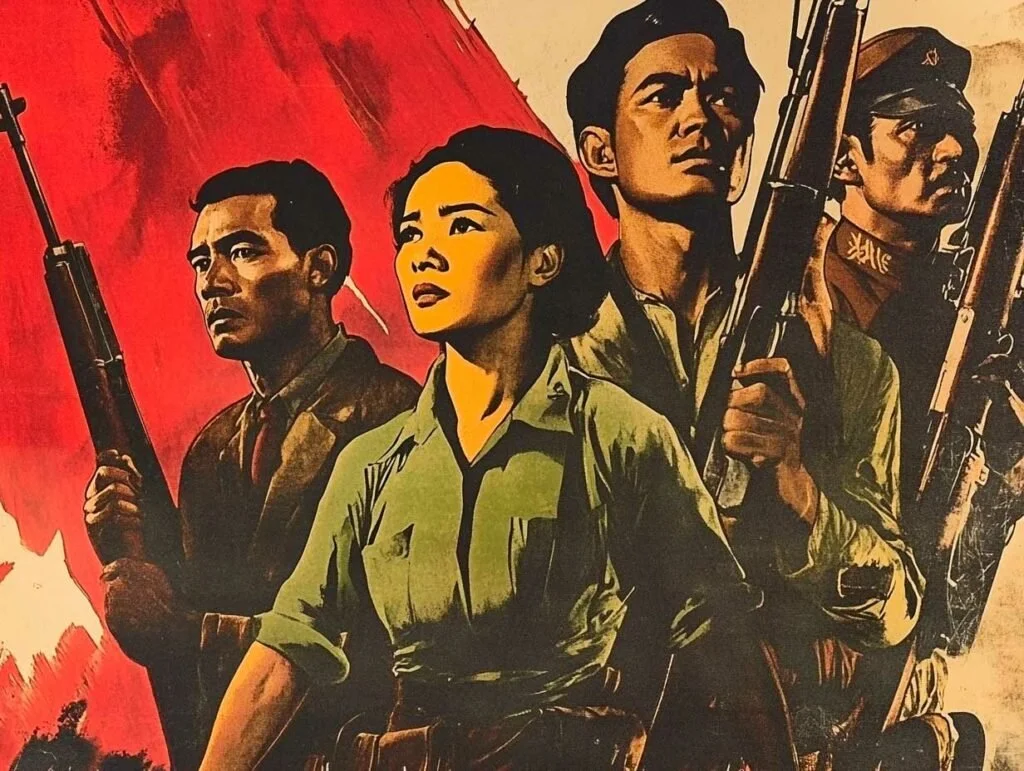
Summary and review
Frameworks for thinking about the end of European imperialism. The process of decolonisation.
End of European imperialism framework:
The European empires began to decline after WW2 for which reasons?
Recipe for mismanaging decolonisation framework:
How did the European imperial countries manage the process of decolonisation?
Reasons decolonisation led to new nation states with significant challenges framework:
What was the legacy of imperialism and the resulting challenges faced by the new nations?
2. The end of the European project in 4 case studies.
1. The end of the Raj. Slowly. slowly, then all at once. 1947
After WW2, the Indian Air Force went on strike in India and the Royal Indian Navy mutinied. In addition, India was also facing civil unrest. The outbreak of the Calcutta Riots in August 1946 between the Muslim and Hindu communities left 3,000 dead and 17,000 wounded. The riots spread to East Bengal, Bihar and the United Provinces. At the same time, the Indian Army was undergoing post war demobilisation and the colossal task of dividing the army between the new states of Pakistan and India, whilst simultaneously trying to curtail the spreading violence.
Independence was almost inevitable after the 1935 Government of India Act that included the following reforms.
self-government at a local level
majority representation in the national government
the process of ‘Indianisation’ in the civil service and the military. By 1945 the Indian army had over 15,000 Indian officers.
The British Prime Minister Attlee, announced that the British would transfer power no later than June 1948. The plan for Partition was a consequence of both the need to divide the British Empire in South Asia and the divisions between the Congress Party (Hindu) and the Muslim League. The Indian leaders accepted the 3 June Partition plan. Independence was brought forward to 15 August 1947 in the vain hope of ending growing communal violence. However the rush to draw up the new state boundaries, led to mass displacement, migration and massacres in the Punjab. Historians estimate that between 200,000 and a million people died during the partition.
To do: questions
How did the 1935 Government of India Act contribute to Indian independence?
Why was India partitioned into two countries?
Research and discuss: What could the British have done better?
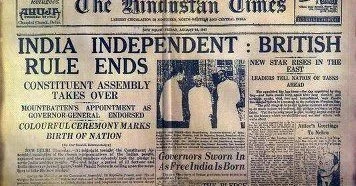
2. Vietnam fights for independence - December 1946 to August 1954
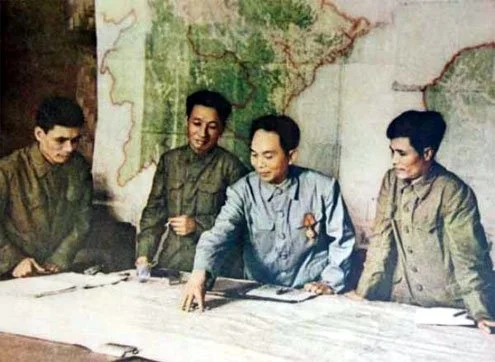
The withdrawal of the Japanese at the end of WW2, led to tension and hostility between the independence seeking Vietnamese (Viet Minh) and the returning colonial French. This led to the outbreak of the First Indochina War in 1946. The Viet Minh had superior numbers but lacked the weapons, munitions and technology of the French.
Led by General Giap, the Viet Minh General and chief strategist, they retreated to remote areas on the border with Laos to train, gather support and instigate a protracted guerrilla war. Under Giap, the Viet Minh avoided direct battle and forced the French forces to fight in often remote areas.
The inability to strike a decisive blow against the Viet Minh and a series of failed military operations led France to seek a political solution. Paris first tried to establish an independent republic of Vietnam, led by the figurehead, emperor Bao Dai, who would still be under the control of the French.
In response the Viet Minh began moving men and supplies into remote areas of French occupied Laos which led to a decisive military confrontation at Dien Bien Phu. The resulting French defeat led to independence and the partition of Vietnam.
To do: Vietnam questions
Which events caused the French to begin to consider a political solution?
What do you think the French hoped to achieve with this approach?
Discuss: Why did the US, England and China allow the restoration of French rule after 1945?
3. The Belgians no longer in the Congo. 1961
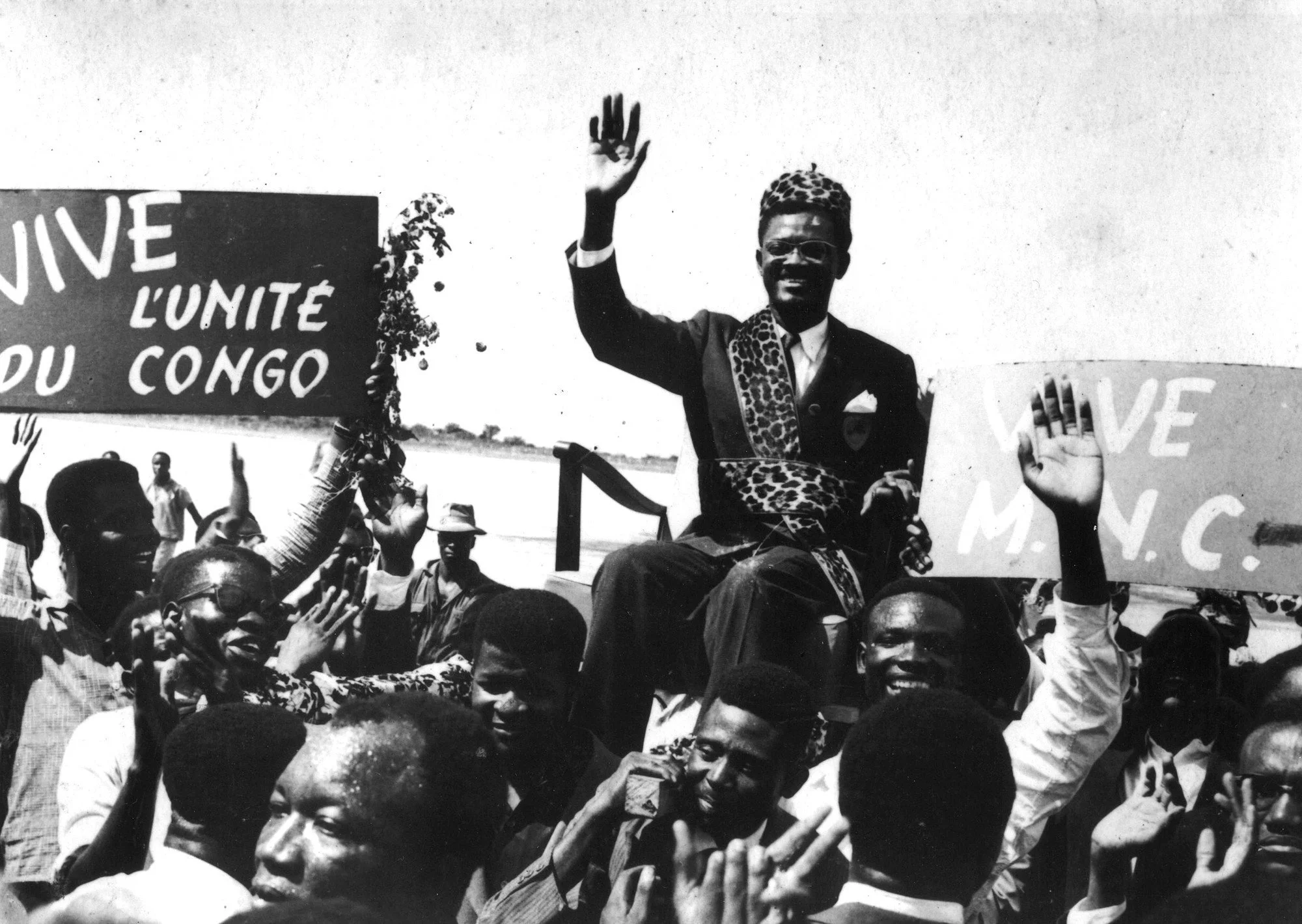
The immense Belgian Congo was one of the richest colonies in Africa: the country's abundant mineral resources were in the hands of the mining companies, while its forests were an important source of rubber for the global economy. Catholic missionaries were very influential in social affairs. In 1959, after several British colonies in Africa had obtained their independence, local nationalist movements began a series of bloody riots in the two main cities of Leopoldville and Stanleyville.
Belgium’s response to independence in the Congo in 1960 was reluctant, destabilising, and self-interested. While Belgium formally granted independence, it did little to prepare Congolese leaders for self rule. Belgium quickly intervened militarily to protect economic interests, supported secessionist movements and undermined the new government, contributing to political chaos.
After the Presidents assassination, ethnic and political conflicts plunged the country into a terrible civil war. This war continued until November 1965 when General Mobutu’s coup established a dictatorship. When Mobuto lost power in 1997, Zaire was characterised by widespread cronyism, corruption and economic mismanagement.
To do: Belgian Congo questions
Briefly summarise using examples the policies of the Belgians in their Congo colony.
What was the impact of these policies on the new republic?
4. : Rawagede. Dutch atrocities in Indonesia. 1947
During the Indonesian War of Independence (1945–1949), the Netherlands launched military operations to regain control after the proclamation of independence by Sukarno in August 1945.
Rawagede. 1947
On 9 December 1947, Dutch troops entered the West Javanese village of Rawagede (now Balongsari). They were searching for a Republican guerrilla commander. When villagers refused to provide information, Dutch forces separated the men from women and children.
Hundreds of Indonesian men were executed. A later UN investigation estimated approximately 150 deaths.
The incident became one of the clearest documented cases of summary execution during the Dutch “police actions.”
Source: Remy Limpach in De brandende kampongs van Generaal Spoor,
‘Dutch units routinely employed summary executions, torture during interrogations, and the systematic destruction of villages suspected of supporting Republican forces. While senior Dutch commanders often framed these measures as necessary counter insurgency tactics designed to restore order. These actions blurred the distinction between military targets and civilian populations. The burning of kampongs (Villages) and collective punishments were intended to deter resistance, but they also deepened Indonesian hostility and strengthened international criticism of Dutch policy.
To do: questions
How does the language used by Dutch authorities shape the interpretation of events at Rawagede?
To what extent did events like Rawagede undermine Dutch claims to moral authority?
Extra Source. Winds of Change
Harold Macmillan, the UK prime minister made the “Winds of Change” speech to the South African Parliament in the 3rd February 1960.
In the period after the Suez Crisis in 1956, the UK was getting out of the empire business.
“The wind of change is blowing through this continent. Whether we like it or not, this growth of national consciousness is a political fact. We must all accept it as a fact, and our national policies must take account of it.”
“In the twentieth century, and especially since the end of the war, the processes which gave birth to the nation states of Europe have been repeated all over the world… The peoples of Africa have shown, by their actions, that they wish to be independent.”
To do: questions
How does Mr Macmilan charecterise the causes of decolonisation in Africa?
Extra: How does the prime minister frame the English response to this process?
3. Sources - Decolonisation by armed struggle
11 Sources Analysis Answer Guide
Don’t forget: Quote often and begin your response with name of the author, not the Source number. Put the source number in brackets at the end of the quote/paraphrasing.
For example:
This is supported by Jones who states that 'History students would be more popular at parties if they used this method.' (Source 3)
More successful responses:
contain relevant evidence (quotes and observations) from sources when required.
Less successful responses
provide responses without reference to any evidence from the source
state that sources are limited without explaining why using evidence
do not assess the nature of sources clearly
do not explain how the nature and origin of the sources are a strength or limitation
do not include the source in the response.
Source 1. Algerian National Liberation Front. (FLN) Founding declaration. 1 November 1954
“Our aim is the national independence of Algeria within the framework of North African unity. The restoration of the sovereign, democratic and social Algerian state within the framework of Islamic principles. Respect for all fundamental liberties without distinction of race or religion. “We call upon all Algerians… to rally to our side in order to save our country and restore it to its rightful place in the world.”
Questions
1. What are two conclusions that can be drawn from the source about the FLN’s justification for armed struggle against France? (2)
Source 2. Indonesian Proclamation of Independence. 17 August 1945.
Independence is the inalienable right of all nations, and therefore colonialism must be abolished in this world because it is not in conformity with humanity and justice. We, the people of Indonesia, hereby declare the independence of Indonesia. Matters concerning the transfer of power and other things will be executed in careful manner and in the shortest possible time.”
Questions
2. Use evidence from the source to describe how the proclamation characterises the end of colonialism in Indonesia (2)
3. Is source 2 a primary or a secondary source? Use evidence from the source to support your answer. (2)
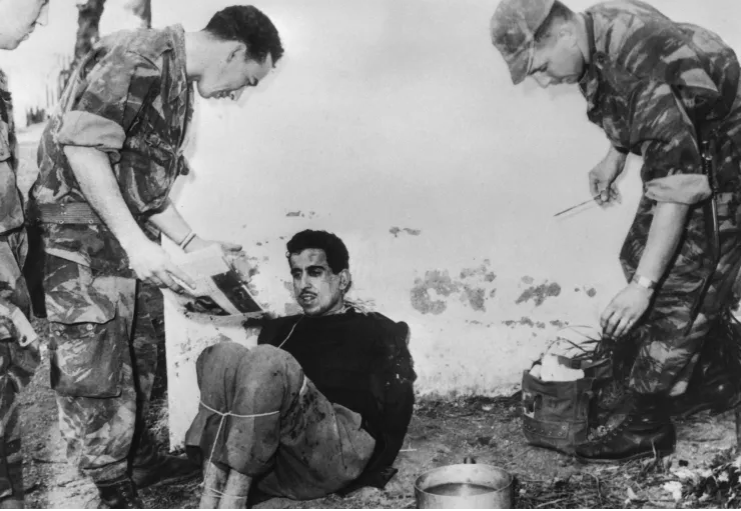
Source 3. Algerian prisoner. 1960
The French forces were accused of using widespread torture during the Algerian independence war.
Questions
4. How is an image like source 3 useful for an historian studying the Algerian conflict? (4)
Source 4. Algeria: France's Undeclared War. Martin Evans. 2012
“Torture became institutionalised during the Battle of Algiers. Though justified by some officers as necessary to defeat terrorism, it undermined France’s claim to be defending republican values and deepened divisions within French society.”
Source 5. De brandende kampongs van Generaal Spoor (The Burning Villages of General Spoor). Remy Limpach. 2016
In the years 1945 to 1949, Dutch forces engaged in what was officially termed “police actions” against the Republic of Indonesia. Yet the evidence from military reports, veterans’ testimonies and archival material demonstrates that extreme violence was not incidental but structural to the campaign. Dutch units routinely employed summary executions, torture during interrogations, and the systematic destruction of villages suspected of supporting Republican forces.
While senior commanders often framed these measures as necessary counter-insurgency tactics designed to restore order, such actions blurred the distinction between military targets and civilian populations.
Questions
5. To what extent does the information in Source 4 support the information in Source 5? Justify your answer with evidence from each source. (4)
6. Evaluate the following statement using evidence from the sources.
“The European powers lost moral authority during decolonisation because of their methods of retaining control?”
Source 3. Algerian prisoner. 1960
4. DIY source analysis
DIY decolonisation source analysis
Develop a source analysis that examines the process of decolonisation in Africa.
Use the following outline for your source analysis.
Questions
Use evidence from the source to describe … (2)
Is Source 2 a primary or a secondary source? Use evidence to explain your answer. (2)
Use evidence from Source 3 to describe what is happening in this image (Cartoon / photo / poster)
Examine Source 4. With reference to the origin and nature of the source, assess the strengths and limitations of the source for historians investigating decolonisation in Africa. (4)
To what extent does the information in Source 5 support the information in Source 6? Justify your answer with evidence from each source. (4)
With reference to all of the sources evaluate the following proposition. (6)
Note. Ensure that you use a range of sources, both primary and secondary.
Source 5. Belgium's Heart of Darkness. History.com
Congolese workers were sent out into the jungle to slash down vines and layer their bodies with rubber latex. Later they would scrape it off their skin, often taking flesh and hair with it. The work was labour intensive and injurious to health; the only economical way to collect it was via the forced mobilisation of Congolese society. The Congo Free State evolved from a vanity possession into a slave plantation. Leopold’s hell operated by an insane logic. Villages were set quotas of rubber and the gendarmerie were sent in to collect it, process that was sped up by looting, arson and rape. If a village failed to reach its quota hostages would be taken and shot. To ensure that the gendarmerie didn’t waste their bullets hunting for food.
Question
Use evidence from the source to describe Begium’s policies in the Congo.(2)
5. The joys and sorrows of newly independent nations
The new nation states faced challenges ………
To do: Why was decolonisation complicated for the new nation states?
List and briefly describe the seven factors that complicated the process of decolonisation. (See slide presentation)
Discuss:
Outline five factors that could have been improved to ensure the success of the newly independent nations.
6. Should the old empires pay reparations?
Should Imperial powers pay reparations to their former colonies?
Reparations: Something done or money paid to make amends or compensate for a wrong.
Activists in favour of reparations argue that centuries of European colonialism have had a tremendous impact on inequality within and among countries. In 2019, the European Parliament passed a Resolution on the Fundamental Rights of People of African Descent. It called for a comprehensive perspective on colonialism and slavery, which recognises their historical and contemporary adverse effects on people of African descent.
The Washington Post. 07/21
'….. the report recommends the necessity of reparations for colonial injustices. This poses a significant question for European countries, which have benefited greatly from wealth stolen in the colonial era. While several are taking initial steps to return some of what was seized to their countries of origin, much more has to be done'
Town Hall Debate: Should we make reparations?
Argue for and against the case for reparations with representatives from the following groups:
○ Former colonies.
○ Former European imperial powers
○ The UN
Things to consider.
What form should the reparations take?
Did the advantages of colonisation outweigh the disadvantages?
Is there a risk that reparations are ‘misallocated’?
Where do we stop? Do other empires have to pay reparations?