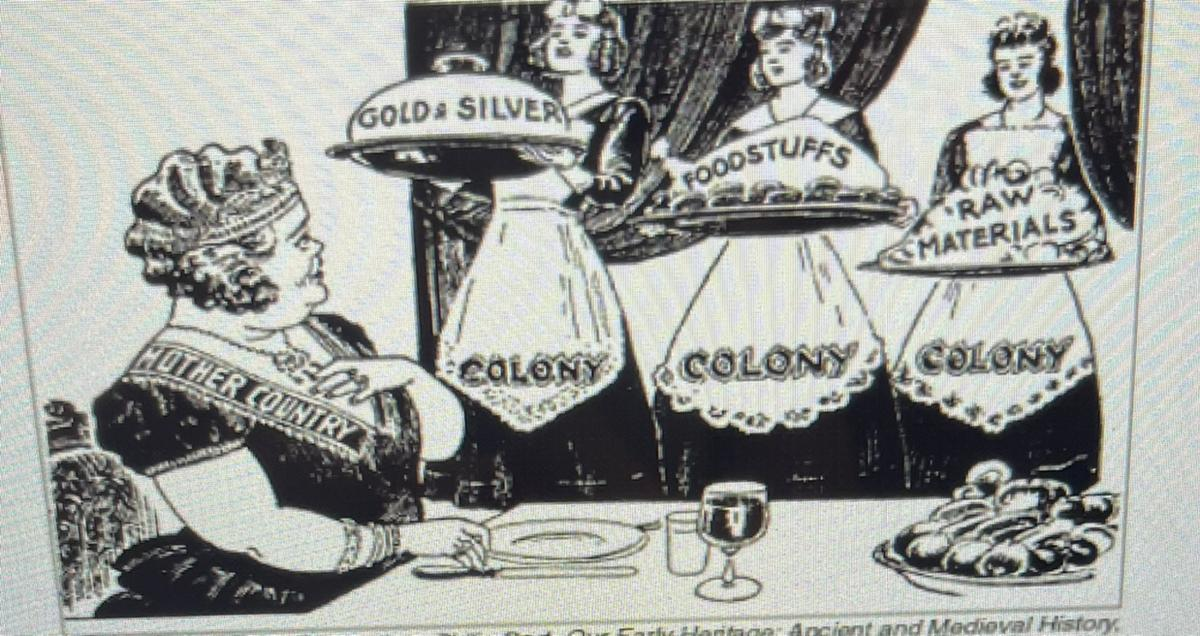
Key question: What are Imperialism and Colonisation?
It is easy to confuse the two concepts. Both imperialism and colonialism describe one country gaining control over another countries people, land and resources.
How is Imperialism different to Colonialism?
Stated simply, Imperialism is the idea and Colonialism is the act.
Imperialism definition - ideas and policy
Imperialism is the policy of expanding a nation’s authority over other nations through diplomacy or force. Imperialism is the idea that drives the practice of colonisation. The aim of imperial policy is to acquire land and impose economic and political domination over another country.
Colonialism definition - action
Colonialism is the act of establishing political and economic domination over another country and its people by settlers/business from a foreign power. Colonisation is the practice of territorial expansion. In most cases, the goal of the colonising countries is to profit by exploiting the human, agricultural and economic resources of the colonised countries . In the process, the colonising country - sometimes forcibly — attempts to impose their religion, language, cultural, and political practices on the indigenous population.
To do: Describe the two concepts in your own words using an example of each to illustrate your description.
1. Were Europeans the first Imperialists?
Imperialism refers to the expansion of state power by the colonisation of other territories, through conquest, settlement, or economic control.
Ancient examples include the Egyptian and Roman Empires. Vast land empires such as the Ottoman Empire and Mongol Empire reshaped Eurasia in their pursuit of trade, resources, and dominance.
‘Look back over the past, with its changing empires that rose and fell, and you can foresee the future.’
Marcus Aurelius 165 AD
The Ottoman Empire
The Ottoman Empire, was created by Turkish tribes in Anatolia (modern day Turkey) it grew to be one of the most powerful states in the world during the 15th and 16th centuries. The Ottoman period spanned more than 600 years and came to an end in 1922.
How do empires expand?
The first period of Ottoman history was characterised by almost continuous territorial expansion. The political, economic, and social institutions of the conquered classical Islamic and Byzantine empires were amalgamated. At its height the empire encompassed most of south eastern Europe, portions of the Middle East now occupied by Iraq, Syria, Israel, and Egypt; North Africa as far west as Algeria; and large parts of the Arabian Peninsula.
The Ottoman empire extended to the boundary of the Persian empire. The two civilisations would continue to clash on the Ottoman western frontier for the next 250 years, draining Ottoman resources.
For much of the Nineteenth Century, Britain had been a staunch defender of what was often referred to as 'The Sick Man of Europe'. Britain had been prepared to overlook the problems of autocracy, corruption and inefficiency of the Ottoman Empire. The Ottomans were supported as a buffer against the much larger threat of Russian Expansion both towards the Jewel in the Crown of India and towards the Dardanelles and the Eastern Mediterranean.
Why do empires end?
The decline of the Ottoman Empire was caused by a combination of internal weaknesses and external pressures. From the 17th C, ineffective leadership, corruption, and slow military modernisation weakened state control. The empire fell behind European powers in technology, industry, and economic development. Rising nationalism among subject peoples led to revolts and territorial losses in the Balkans. Trade routes shifted away from Ottoman lands, reducing wealth and revenue. Repeated military defeats, especially against Russia and Austria, further eroded power. By the early twentieth century, political instability and involvement in global conflict accelerated collapse.
To do: Ottoman empire questions
Explain how the Ottomans integrated the new territories in their rapidly expanding empire.
List the primary reasons for the decline of the Ottoman empire.
Discuss: How do empires survive for extended periods despite overwhelming evidence of decline?
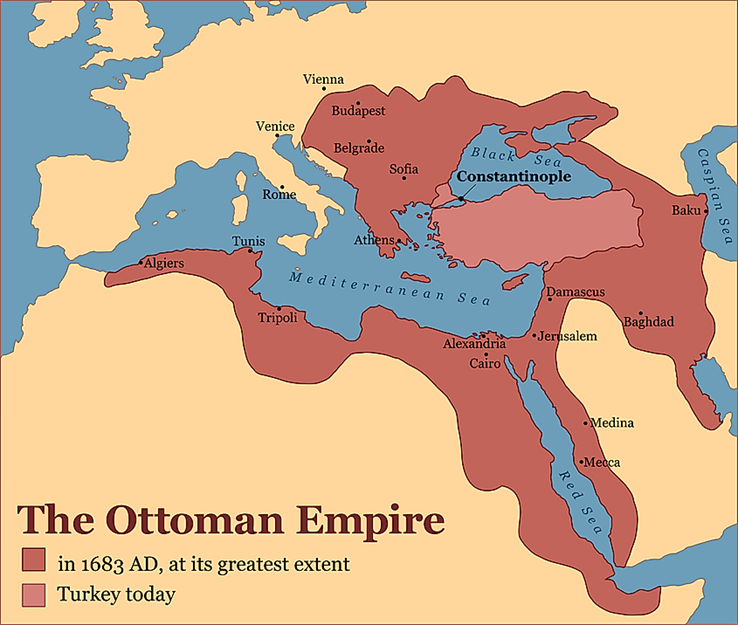
Source. The Ottomans. Harvard University Center for Middle Eastern Studies. 2003.
The Ottomans developed an innovative, flexible and evolving system of administrative institutions that helped them expand and govern their empire. When they conquered new territory, they often left local elites and customs in place so as not to alienate the population. They carried out detailed surveys of the population and resources of their empire to set rates of taxation.
Several military institutions contributed to Ottoman strength. The timar system distributed rights to collect taxes over grants of land to military officers in exchange for their providing help and supplies for military ventures. While this system seems similar in some ways to European feudal custom, the Ottomans maintained central control because the grants were not hereditary and more government functions were centralized. For example, the courts of law were independent of local fief-holders.
Another rather cruel but effective custom was that of royal fratricide. During the first half of Ottoman dynastic rule, when a sultan ascended the throne, he would have his brothers put to death. This practice was sanctioned because it prevented long and bloody civil wars and rebellions among rivals for the throne. In later Ottoman periods, male family members were not always executed but were imprisoned in “the golden cage” in the Topkapi Palace so that they would not present a threat to the ruler. Many historians believe that the princes’ restricted lifestyle and lack of worldly experience made them poor leaders once they became sultan and thus weakened the Empire.
To do: questions
Which successful Ottoman governance strategies does the source identify? (4)
Strategies for a successful empire: Tips from the Mongols
Use the following to describe the Mongol imperial strategy.
Strategy 1. The Mongols - conquer the world's largest land empire.
The Mongol Empire (1206-1368) was founded by Genghis Khan (r. 1206-1227), first Great Khan or 'universal ruler' of the Mongol peoples. Genghis forged the empire by uniting nomadic tribes of the Asian steppe and creating a devastatingly effective army with fast, light, and highly coordinated cavalry. At its peak 100 years later, the Mongol empire stretched from the Pacific Ocean to Eastern Europe, an area of 30 000 000 sq / km.
1. How did the Mongols conquer their empire so quickly?
2. Use an annotated map to show the extent of the Mongol empire.
Strategy 2. Establish and maintain power
Mongol tribal leaders had traditionally achieved and then maintained their position of power by distributing war booty amongst their loyal followers and Genghis was no different. However, the scale of the Mongol military success allowed for the unprecedented mobilisation of peoples, goods and ideas.
3. What was the traditional practice used by the Mongols to maintain power amongst their dominions.
4. Can you see a problem with this policy?
Strategy 3. Make extensive use of foreign experts and advisors.
The Mongol Empire relied on foreign specialists to manage its vast, diverse territories. Conquered engineers, administrators, doctors, and artisans provided skills the nomadic Mongols lacked. Using foreigners reduced reliance on local elites, improved taxation and communication, and strengthened military technology, especially in siege warfare and logistics across the expanding empire.
Chinese engineers skilled at making and using siege weapons such as catapults and battering rams.
Muslim scholars / civil servants were used to govern the rapidly growing empire
Religious leaders of all faiths were invited to share their philosophy
5. Use examples to show how the Mongols used foreign experts to support their empire.
6. Suggest reasons why the Mongols required talented people from across the empire to aid with governance?
Strategy 4: Manage and encourage trade in goods and ideas
The Mongols promoted cultural, religious and economic exchange because it strengthened and enriched the empire. The army set up and maintained vast networks of staging posts where riders could rest and exchange horses. Mongol conquests reopened overland trade routes. Once the Mongols had control of the vast trade networks between Asia, the Middle East and Europe. (Remember the Silk Rd?) these posts were converted to trading centres.
7. Use annotated maps to show the extent of Mongol trade networks.
8. How did the Mongols manage these extensive trade networks and keep them safe for travellers and traders?
9. How do empires benefit from the promotion and control of trade?
“The Greatest Happiness is to scatter your enemy and drive him before you. To see his cities reduced to ashes. To see those who love him shrouded and in tears. And to gather to your bosom his wives and daughters..”
“In the Great Mongol Empire, Mongols governed by a written law called the ‘Ih Zasag,’ which is translated as ‘the Great Order.’ It was an era when the Mongols strove to establish a new world order, thus, justice, peace and cooperation in their relations with other states and peoples.”
2. Causes of the European Imperial Project
Key question: What were the factors that led to the age of European Imperialism?
The Age of European Imperialism included the colonisation of the Americas between the 15th and 19th centuries, as well as the expansion of the United States, Japan, and the European powers during the late 18th, 19th and early 20th centuries.
To understand the impact of different empires that existed during the Nineteenth Century, we must seek to understand the how and why of "imperialism." We know that industrialised countries like Britain, France, and the United States built and ruled empires in this period. But why then? What motivated the governments and their people? What made it possible for them, at that particular point in history, to expand their authority so far around the globe?
The truth is, Imperialism was or is never idealistic, it has always been driven by economic or strategic interests. Charley Reese
Background briefing: Causes of the European Imperialism.
Did the industrial revolution cause European imperialism?
Michael Adas argues in his book, Machines as the Measure of Men (1989), the most important factor in the expansion of European colonisation in the 18th and 19th centuries was the period of rapid industrialisation that preceded it.
Reason 1. Industrialised countries were now able to conquer and rule other societies, especially those that were not Industrialised. Machine guns and artillery obviously played a role, but when only one side has steamships, railroads, telegraphs, and new medicines, they have a great advantage occupying and ruling whoever doesn't have those tools.
Reason 2. Industrialisation also provided one of the motives for empire building, trade. Industry needed raw material to turn into goods, and it needed markets in which to sell them. Colonies provided both. The minerals of a colony's land could be mined, its forests cut, its fish caught. The empires factories could produce goods that could be sold to people in the colonies, who would have little choice but to buy them.
To do: questions
Write a short paragraph to explain the reasons for the expansion of European imperialism.
How did the Atlantic slave trade reflect the needs of the new industrial empires of Europe?
Use a map to illustrate your explanation.
When do you think these cartoons were produced?
Use evidence from the cartoons to explain the messages of the cartoonists.
Refer to the impacts of the industrial revolution to explain why China would have been attractive to European empire builders.
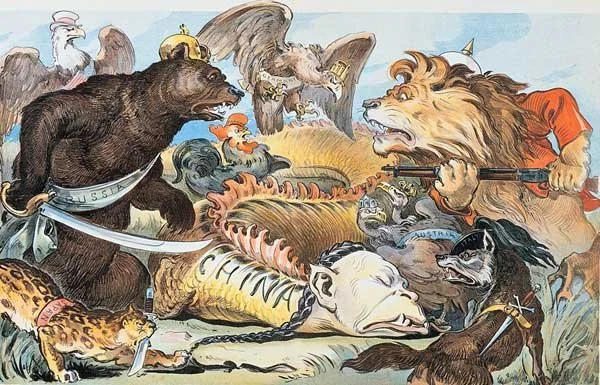
Cartoon 2. ‘Seizing the dragon’.
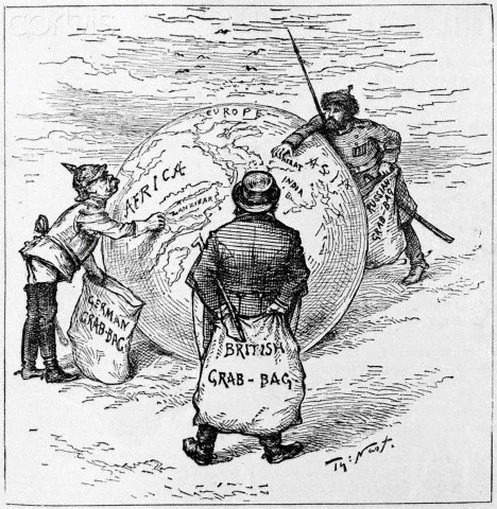
Cartoon 1. ‘Grab Bag’
Sources. The European Age of Imperialism Begins
11 Sources Analysis Answer Guide
Don’t forget: Quote often and begin your response with name of the author, not the Source number. Put the source number in brackets at the end of the quote/paraphrasing.
For example:
This is supported by Jones who states that 'History students would be more popular at parties if they used this method.' (Source 3)
More successful responses:
contain relevant evidence (quotes and observations) from sources when required.
Less successful responses
provide responses without reference to any evidence from the source
state that sources are limited without explaining why using evidence
do not assess the nature of sources clearly
do not explain how the nature and origin of the sources are a strength or limitation
do not include the source in the response.
Source 1. The Age of Imperialism (1870–1914). Tamaqua (2022)
'European Imperialism did not begin in the 19th C. From the 16th to 19th C, European nations sought trade routes with the Far East, explored the New World, and established settlements in North and South America as well as in Southeast Asia. They set up trading posts and gained footholds on the coasts of Africa and China, and worked closely with the local rulers to ensure the protection of European economic interests. Their influence during this period, however, was limited. This changed during the Age of New Imperialism that began in the 1870s, European states established vast empires mainly in Africa, but also in Asia and the Middle East.'
Question
1. What are two conclusions that can be drawn from the article about the 'old imperialism'? (2)
Source 4. The White mans burden. Rudyard Kipling
"The White Man's Burden" is a poem by the British Victorian poet and novelist Rudyard Kipling. In 1899 Kipling revised it to exhort the American people to conquer and rule the Philippines. Conquest in the poem is not portrayed as a way for the white race to gain individual or national wealth or power. Instead, the speaker defines white imperialism and colonialism in moral terms, as a “burden” that the white race must take up in order to help the non-white races develop civilization.
Question
5. How does the poet Kipling) characterise the the reasons for European imperialism? (2)
Source 3. Imperialism: A Study. Hobson. J (1902)
The economic theory of imperialism was introduced by J. A Hobson, a socialist economist. Hobson argued that capitalist societies produce an excess of goods and capital because they underpay their workers. To find outlets for these surpluses, capitalist powers sought undeveloped nations where they could sell their goods and invest their money, and obtain raw materials for their factories. In order to make sure these countries protected their property and repaid their loans, bankers and business men put pressure on their own governments to intervene in the affairs of undeveloped countries. According to Hobson, imperialism was not in the economic interests of the society of the imperial power. However the bankers and businessmen won the support of their countrymen by appealing to the idealism and patriotism of the people in their country.
Question
3. How does the source charecterise the reasons for the expansion of European imperial ambitions?
4. Who does Hobson view as the main beneficiaries of the expansion of European colonies?
Source 2. On Colonies and Colonization. John Stuart Mill (1848)
'If it is desirable, as no one will deny it to be, that the planting of colonies should be conducted, not with an exclusive view to the private interests of the first founders, but with a deliberate regard to the permanent welfare of the nations afterwards to arise from these small beginnings; such regard can only be secured by placing the enterprise, from its commencement, under regulations constructed by the government alone.'
Question
2. Is source 2 a primary or a secondary source? Use evidence from the source to support your answer. (2)
Source 5. The Age of Imperialism: Building Global Empires
The New Imperialism: European nations move aggressively to increase their colonial holdings in Africa, India and Asia between 1870 and 1914, with ominous consequences.
Watch the presentation from 7:18 to 8:00.
Questions
6. What are the disadvantages of imperialism for colonised countries according to Mr Fitzgerald? (2)
Take up the White man's burden
Send forth the best ye breed
Go bind your sons to exile
To serve your captives' need;
To wait in heavy harness
On fluttered folk and wild
Your new-caught, sullen peoples,
Half devil and half child.
Source 6. Imperialism. ThoughtCo.
'In its most familiar form, colonialism involves the relocation of people to a new territory as permanent settlers. Once established, the settlers maintain their loyalty and allegiance to their mother country while working to harness the new territory’s resources for the economic benefit of that country. In contrast, imperialism is simply a philosophy of the imposition of political and economic control over a conquered nation or nations through the use of military force and violence..'
Source 7. Colonial Banquet. Punch 1879
Questions
7. To what extent does the information in Source 6 support the information in Source 7?
Justify your answer with evidence from both sources. (4)